Masanao Kurihara, the creator of Uramiya Honpo, has revealed that he began avoiding Black characters in his manga after receiving a request to replace a Black antagonist with a white character in 2006.
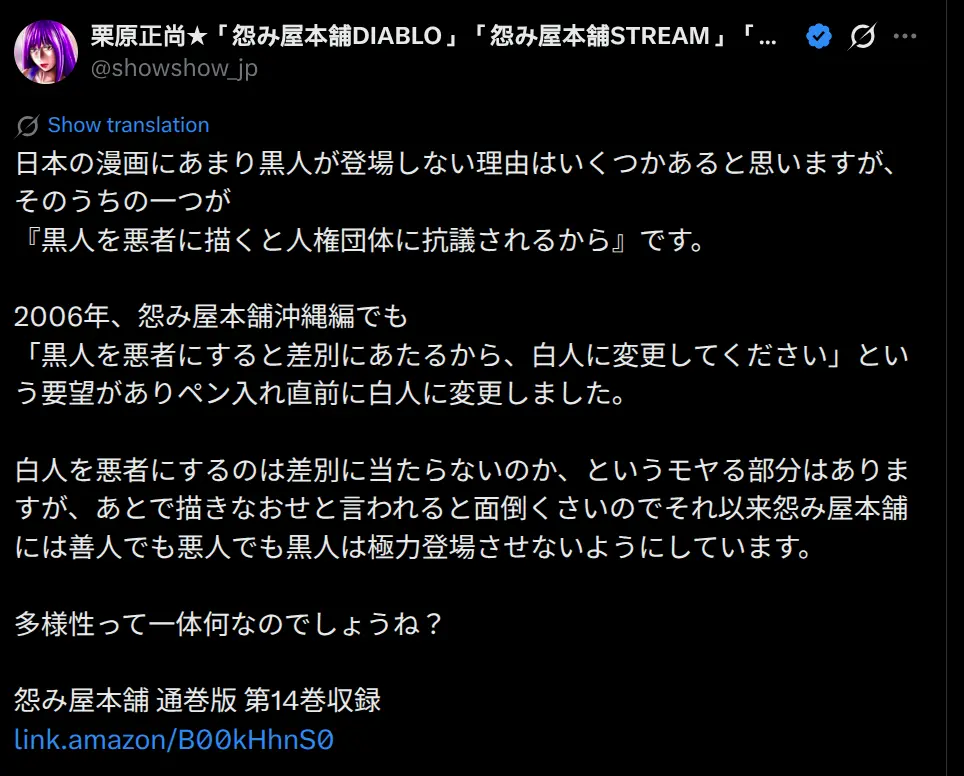
The manga artist shared his experience on X, explaining that the request came shortly before he was due to ink the artwork for the Okinawa arc of Uramiya Honpo. According to Kurihara, the concern was that portraying a Black character as a villain could be considered discriminatory and lead to complaints from human rights organizations.
Kurihara said the experience changed how he approached character representation in his work. Since then, he has tried to avoid including Black characters, whether as heroes or villains, because he does not want to deal with similar requests to redraw his work.
His post ended with a pointed question about the meaning of diversity, sparking discussion about racial representation and creative freedom in manga.
In his post on X, Kurihara explained that there are several possible reasons why Black characters rarely appear in Japanese manga, identifying the fear of discrimination complaints as one of them.
He recalled an incident from 2006 while working on the Okinawa arc of Uramiya Honpo.
According to Kurihara, he received a request to change a Black antagonist into a white character because depicting a Black person as a villain could be considered discriminatory.
The request arrived just before he was due to complete the final inking of the artwork, forcing him to change the character at the last minute.
Kurihara wrote:
“I think there are several reasons why Black characters rarely appear in Japanese manga, and one of them is that human rights organizations may protest if Black people are portrayed as villains.”
He then described the request he received in 2006:
“Even in the Okinawa arc of Uramiya Honpo, in 2006, I received a request saying, ‘Depicting a Black person as a villain would constitute discrimination, so please change the character to a white person.’ I changed the character to a white person just before the final inking.”
Kurihara did not identify who made the original request in his post.
Manga Creator Questions the Double Standard Behind the Request
Kurihara also questioned why depicting a Black character as a villain would be considered discriminatory while depicting a white character in the same role apparently did not raise the same concern.
He wrote:
“It leaves me wondering: Isn’t depicting a white person as a villain also discrimination?”
Rather than risk being asked to redraw his work again, Kurihara said he decided to avoid the issue altogether.
“Having to redraw something later is a hassle, so ever since then, I’ve tried to avoid including Black characters in Uramiya Honpo as much as possible, whether they’re good people or bad people.”
His explanation points to a possible unintended consequence of the request he described. In attempting to avoid a potentially controversial portrayal, Kurihara says he instead chose to limit the inclusion of Black characters altogether.
The artist concluded his post by asking:
“What exactly is diversity?”
His comments raise questions about whether avoiding the portrayal of a particular racial group altogether actually addresses concerns about representation, or whether it creates a different problem for creators trying to tell their stories without facing demands for revisions.
The Incident Dates Back to 2006
Although Kurihara shared his experience recently, the incident itself dates back to 2006, when he was working on the Okinawa arc of Uramiya Honpo.
The distinction is important because his post describes a personal experience from nearly two decades ago. It does not establish that all Japanese publishers follow the same approach or that Black characters are generally prohibited from appearing as villains in Japanese manga.
Kurihara’s account instead illustrates how one editorial request, as he remembers it, affected his creative decisions for the series over the years that followed.
The post also does not establish whether the request reflected a formal publishing policy or the position of a particular individual or organization.
Nevertheless, Kurihara’s explanation has brought renewed attention to the complicated questions surrounding race, representation and creative freedom in manga.
Manga Creator’s Comments Raise Questions About Diversity and Creative Freedom
Kurihara’s account highlights a tension that can arise when creators face concerns about how racial groups are represented in fiction.
One concern is that repeatedly depicting members of a particular group as villains can reinforce harmful stereotypes. At the same time, restricting creators from portraying members of that group as antagonists can limit the range of characters and stories they can develop.
In Kurihara’s case, he says the request he received led him to avoid including Black characters in Uramiya Honpo, regardless of whether they would have been portrayed positively or negatively.
His final question, “What exactly is diversity?”, reflects his frustration with that outcome.
However, the account represents Kurihara’s personal experience and interpretation of the incident. It does not establish a broader industry-wide policy or demonstrate that all concerns about racial representation lead to the same result.
The discussion ultimately raises a question that extends beyond manga: how can creators address concerns about harmful stereotypes without unnecessarily restricting the range of characters they can portray? Bookmark Otaku Mantra for more manga news and updates!
About Uramiya Honpo
Uramiya Honpo is a manga series written and illustrated by Masanao Kurihara and published by Shueisha.
The series follows a mysterious woman known as Uramiya, who takes on requests from people seeking revenge against those who have wronged them. Her methods often involve exposing wrongdoing and delivering forms of punishment to people who believe they can escape the consequences of their actions.
The manga explores revenge, crime, social problems and the darker aspects of human behaviour. Its stories frequently involve morally complicated characters and situations, making character portrayals an important part of the series.