A debate over manga piracy, official translations and international accessibility has erupted again on social media, with Japanese manga creators defending their work against unauthorized distribution while overseas readers argue that publishers need to make legal manga easier to access.
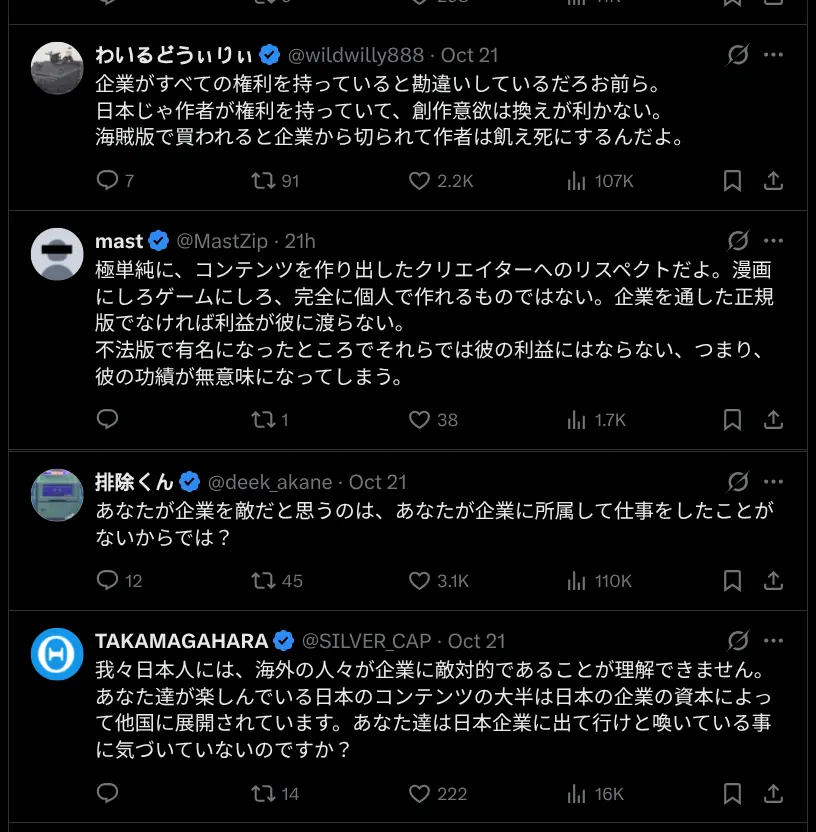
The latest discussion gained traction on X between October 20 and 22, 2026, after a Japanese manga artist addressed international readers directly, explaining why piracy can threaten creators’ livelihoods and the future of smaller manga publishers.
The posts quickly drew responses from overseas fans who argued that publishers should offer accessible reading platforms, accurate translations and more international releases instead of expecting readers to purchase manga that may not officially exist in their countries.
At the center of the argument is a question that continues to divide the manga community: Should readers bear the responsibility of avoiding piracy when publishers have not made their works legally available overseas, or must the industry do more to meet international demand?
Japanese Manga Artist Explains Why Piracy Hurts Creators
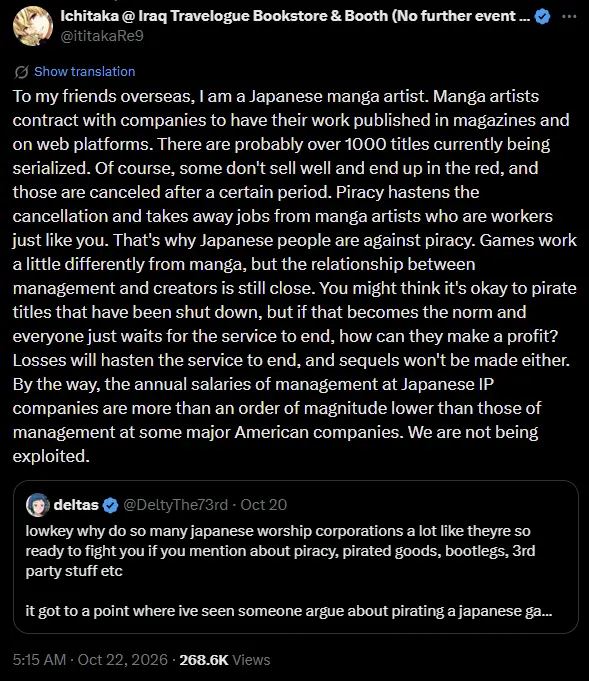
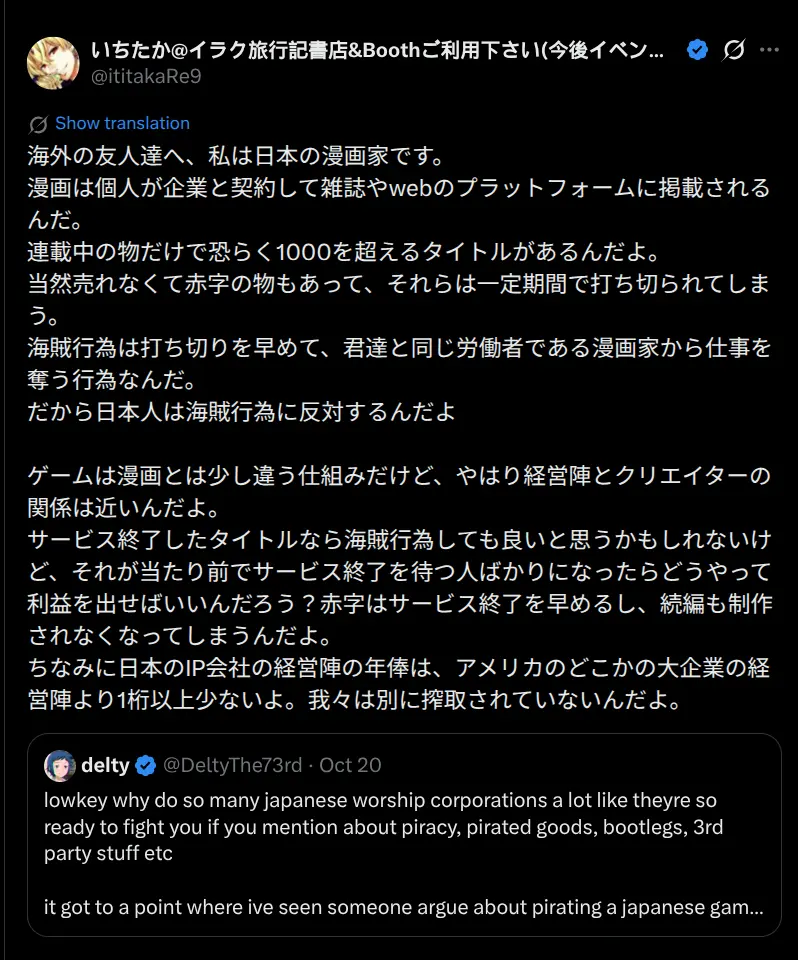
Japanese manga artist Ichitaka (@ititakaRe9) addressed overseas readers in a series of posts explaining the financial and professional realities of working in Japan’s manga industry.
Ichitaka said manga artists sign contracts with publishing companies to have their work published in magazines and on digital platforms. According to the artist, more than 1,000 manga titles may be serialized in Japan at a time, and not every series becomes commercially successful.
Some titles struggle to sell enough copies and eventually end their serialization. Ichitaka argued that piracy can accelerate that process by taking away revenue from legitimate sales, potentially costing manga artists their jobs.
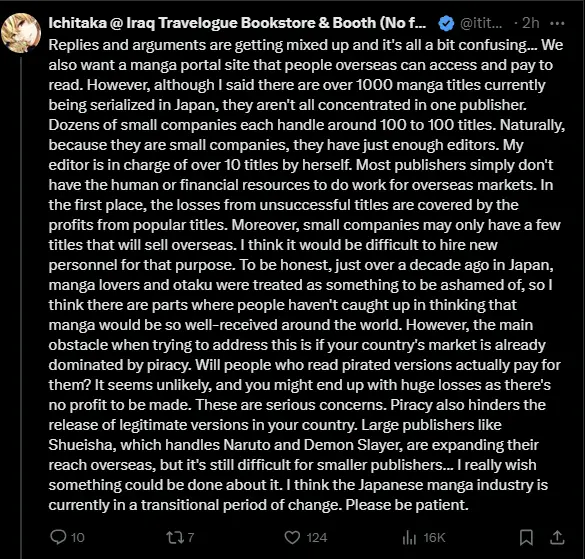
The artist also pointed out that the Japanese manga industry includes many smaller publishers that lack the staff and financial resources to distribute their entire catalogues overseas.
While major publishers such as Shueisha have expanded their international reach, smaller companies may have only a handful of titles suitable for overseas licensing. Ichitaka argued that those companies cannot always afford to hire dedicated teams to manage translations, localization, marketing and international distribution.
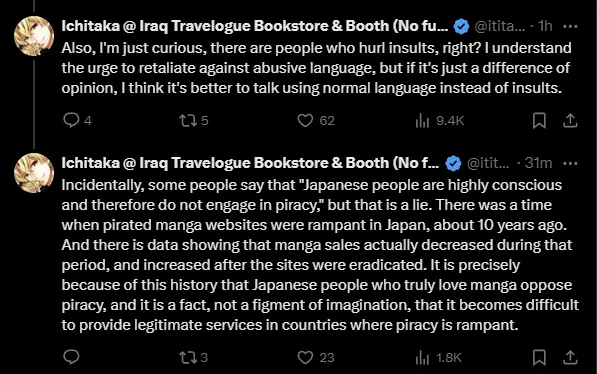
“That’s why Japanese people are against piracy,” the artist wrote while explaining how unauthorized distribution can affect creators and publishers.
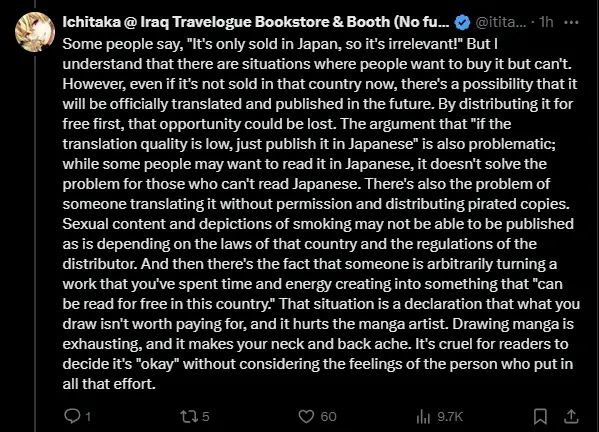
Ichitaka also questioned the idea that piracy becomes acceptable once a publisher discontinues a series. If readers continue waiting for a service to end before turning to unauthorized copies, the artist argued, publishers lose opportunities to earn revenue and produce sequels.
Overseas Fans Want Accessible Platforms And Official Translations
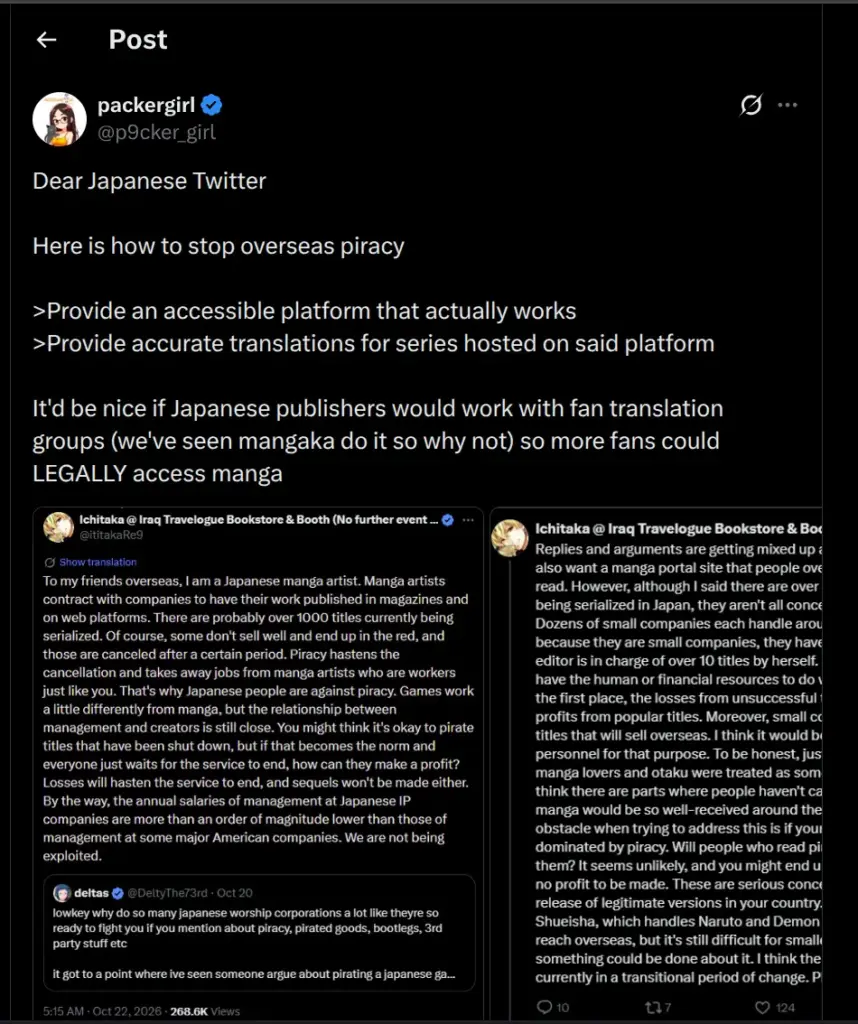
The discussion took another direction after X user @p9cker_girl addressed Japanese readers directly, offering what they described as a way to reduce overseas piracy.
The post proposed three changes:
- Provide an accessible platform that works reliably.
- Provide accurate translations for the manga hosted on that platform.
- Allow Japanese publishers to work with fan-translation groups so more readers can legally access manga.
The user argued that publishers could collaborate with experienced fan translators instead of treating the entire community as a problem.
“It’d be nice if Japanese publishers would work with fan translation groups,” the post stated, adding that some manga creators had already demonstrated that collaboration with fans was possible.
The argument reflects a recurring frustration among international readers: a manga may have a dedicated overseas audience without having an official translation or a convenient legal way to read it.
Readers in some countries face regional restrictions, delayed releases, incomplete catalogues or a lack of translations into their languages. In those situations, an official Japanese release does not automatically provide an accessible option for someone who cannot read Japanese.
However, the proposal also raises practical questions about licensing, translation rights, editorial approval and compensation. Publishers cannot necessarily authorize a fan translation without first determining who holds the relevant rights and how the work should be distributed.
Even so, the suggestion highlights an important point in the debate: improving legal access could help publishers reach readers who currently struggle to find official editions.
Japanese Creators Say International Distribution Is Not That Simple
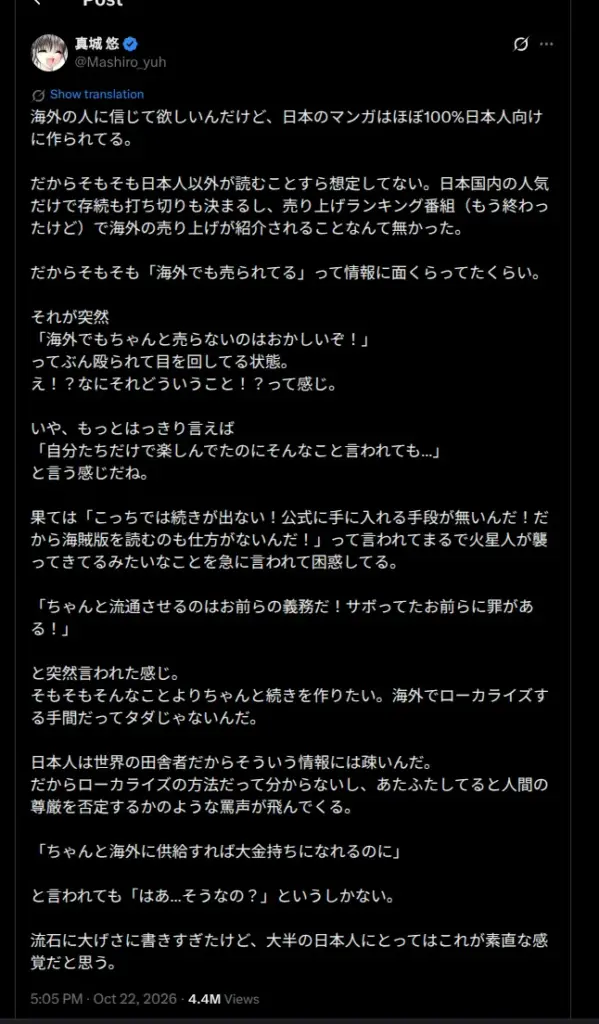
Another Japanese AI creator, Yuu Mashiro (@Mashiro_yuh), offered a different perspective on why some manga remain unavailable overseas.
In a lengthy post, Mashiro explained that much Japanese manga originally targeted readers in Japan rather than an international audience. Publishers often made decisions based on domestic readership, sales and serialization performance without necessarily planning for global distribution.
The creator argued that some international readers now expect Japanese publishers to offer their favourite manga worldwide, even when publishers never established the necessary distribution arrangements.
Mashiro also pointed out that localization requires additional work and resources. Translating a manga involves more than changing the dialogue into another language, and international distribution can create further costs and operational challenges.

The post expressed frustration with the expectation that Japanese creators should somehow solve every problem related to overseas accessibility, even when they do not control licensing or distribution decisions.
The distinction matters because manga creators and publishers do not always control the same parts of the business. An artist may create a manga for a Japanese magazine, while the publisher controls the rights, a separate company handles overseas licensing, and another service distributes the translated edition.
As a result, telling an individual artist to make a series available internationally may not address the actual obstacle preventing its release.
Some Overseas Readers Say Publishers Should Do More
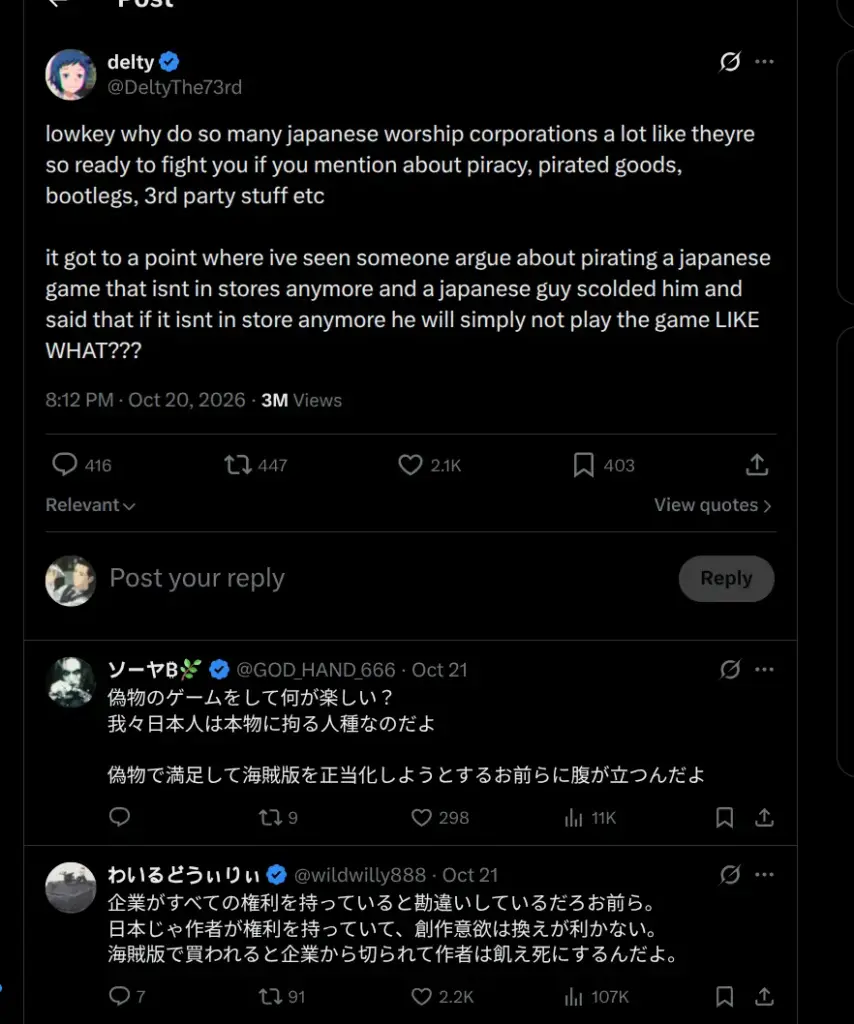
The debate has also attracted criticism of the way some Japanese users discuss piracy and foreign readers.
Some overseas fans argue that publishers cannot reasonably expect readers to buy official translations when those translations do not exist in their regions. Others point out that even available editions can be expensive, particularly for readers dealing with differences in purchasing power and local distribution costs.
The argument is not necessarily that manga artists should work without compensation. Instead, some fans say the industry should create more convenient and affordable legal options so readers can support the creators whose work they enjoy.
Others believe piracy can introduce new readers to a series who may later purchase official volumes or merchandise. However, that argument does not establish that piracy reliably increases sales, and the financial impact can vary between titles and markets.
Japanese creators have pushed back against the suggestion that unauthorized reading automatically benefits them. Their concern is that large audiences on piracy websites do not necessarily translate into income for the people producing the manga.
The argument has become increasingly personal on social media, with some users responding to disagreement through insults rather than discussing the problems with international publishing.
Ichitaka also asked readers to avoid insulting people simply because they hold different opinions.
Why Smaller Manga Publishers Face A Different Problem
One of Ichitaka’s central points concerns the difference between large publishers and smaller companies.
Major publishers have the resources to negotiate international licensing agreements, establish digital distribution channels and invest in localization. They may also have enough popular titles to justify the cost of maintaining overseas operations.
Smaller publishers can face a different situation. They may have a limited number of series with international potential, fewer employees and less money to spend on translations or marketing.
For those publishers, expanding overseas does not necessarily mean that every title will generate enough revenue to cover the costs.
The artist argued that piracy makes the situation harder by reducing the opportunities for legitimate distribution to generate income. If a publisher struggles to earn a profit on a title, it may become less willing to invest in future volumes or similar projects.
That is the concern behind Ichitaka’s argument that piracy can threaten not only individual manga artists but also the smaller publishing businesses that employ them.
At the same time, limited international distribution can push readers toward unauthorized sources. That creates a difficult cycle: limited legal access encourages piracy, while piracy can undermine the business case for investing in official releases.
Breaking that cycle requires more than asking readers to change their behaviour or asking publishers to translate everything immediately.
Japan Is Already Exploring Better International Manga Distribution
The debate comes as Japan takes steps to expand official manga distribution overseas.
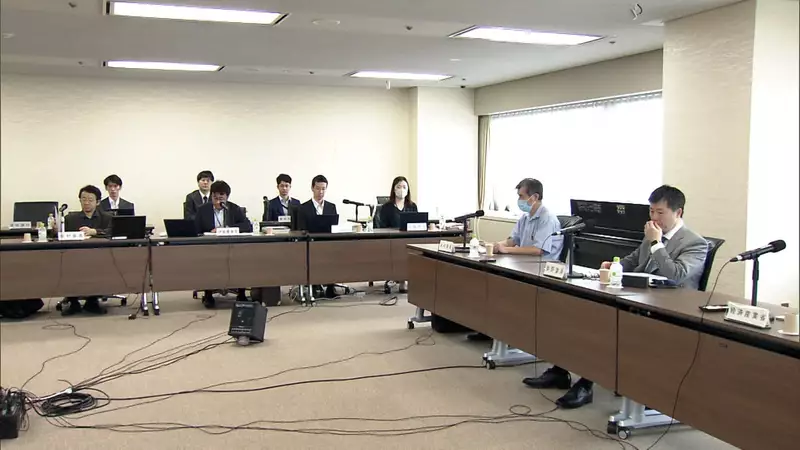
In June 2026, Japan’s Agency for Cultural Affairs established a public-private initiative called the Consortium for Building a Platform for Next-Generation International Manga Distribution.
The initiative brings together Japanese publishers and other industry participants to explore ways to expand the international distribution of officially translated manga.
Orange Inc., the studio behind Beasters and Trigun Stampede, is working on manga translation and digital distribution, joined the consortium and said it would contribute experience in localization, overseas distribution and user experience.
The broader objective is to make more Japanese manga legally accessible to readers worldwide while reducing the losses associated with piracy.
The Japanese government has also reported substantial estimated losses from online piracy of Japanese content. In January 2026, the Ministry of Economy, Trade and Industry and the Content Overseas Distribution Association estimated that online piracy caused ¥5.7 trillion in losses for digital content in 2025.
That figure covers Japanese digital content more broadly, rather than manga alone, and comes from a survey-based estimation method. It should not be interpreted as a verified accounting of sales that publishers would otherwise have made.
These efforts show that the Japanese industry and government recognize that international access is part of the piracy problem. Expanding official distribution could help readers find legitimate editions while giving publishers and creators better opportunities to earn revenue from overseas audiences.
Can Fan Translators And Japanese Publishers Work Together?
The proposal to collaborate with fan translators remains one of the more interesting suggestions in the current debate.
Fan-translation groups have helped international audiences discover manga that lacked official translations. Some translators also develop significant knowledge of a series, its terminology and its cultural context over many chapters.
That experience could potentially benefit official localization projects. Publishers could consider working with qualified translators under agreements that establish compensation, quality standards, rights and editorial oversight.
Even the official illustrator of Kengan Ashura, Daromeon, criticized the initial official English translation of the manga for reading unnaturally and poorly and compared it side-by-side with an unofficial fan English translation, stating how much they are better than the actual translation and how much smoother and more natural the fan-made version was.
However, fan translators cannot automatically distribute copyrighted manga legally simply because their translations are accurate or their intentions are good. Rights holders must authorize the distribution, and publishers need to determine how such arrangements fit their existing contracts.
The idea is therefore not as simple as allowing every fan-translation group to publish whatever it wants. Instead, it raises the possibility of creating a legitimate path for translators and publishers to collaborate, particularly for titles that currently lack official overseas releases.
Whether that approach becomes practical on a larger scale will depend on publishers’ willingness to experiment with licensing and localization models.
Manga Piracy Debate Highlights A Larger Problem With Global Access
The latest discussion demonstrates how difficult it can be to balance the rights of creators with the expectations of an international audience.
Japanese creators are asking overseas readers to recognize the work, time and money that go into producing manga. They argue that unauthorized distribution can harm the people responsible for creating the stories, particularly when publishers depend on sales to decide whether a series continues.
International readers, meanwhile, are asking publishers to recognize that global popularity creates demand that existing distribution arrangements do not always satisfy. When legal editions are unavailable, expensive or difficult to access, readers may turn to unauthorized sources.
Neither concern disappears simply because the other side makes a valid point.
Piracy does not become harmless because a translation is unavailable. Equally, telling readers to avoid piracy does not create an official translation or make a region-restricted service accessible.
For publishers, the challenge is to expand legal distribution while maintaining a business model that compensates creators. For readers, the question is how to support the work they enjoy without assuming that unauthorized copies have no consequences.
The future of manga’s international growth may depend on addressing both sides of the problem: protecting creators’ rights and making official manga easier to access worldwide. Bookmark Otaku Mantra for more anime, manga and Japanese publishing news and updates!