From fabricated Tokyo Ghoul and Naruto remakes to a rumoured Hunter × Hunter movie, misleading entertainment claims are spreading across X, Instagram and even Japanese online communities. The growing trend also raises questions about recycled news, social media credibility and how fans distinguish satire from genuine announcements.
A growing wave of fabricated anime and entertainment news is circulating across social media, with several accounts posting convincing-looking announcements about major anime franchises, Hollywood productions and video games. Some of these claims have attracted millions of views, while others have been reposted by numerous creators and entertainment pages, allowing the rumours to travel far beyond their original sources.
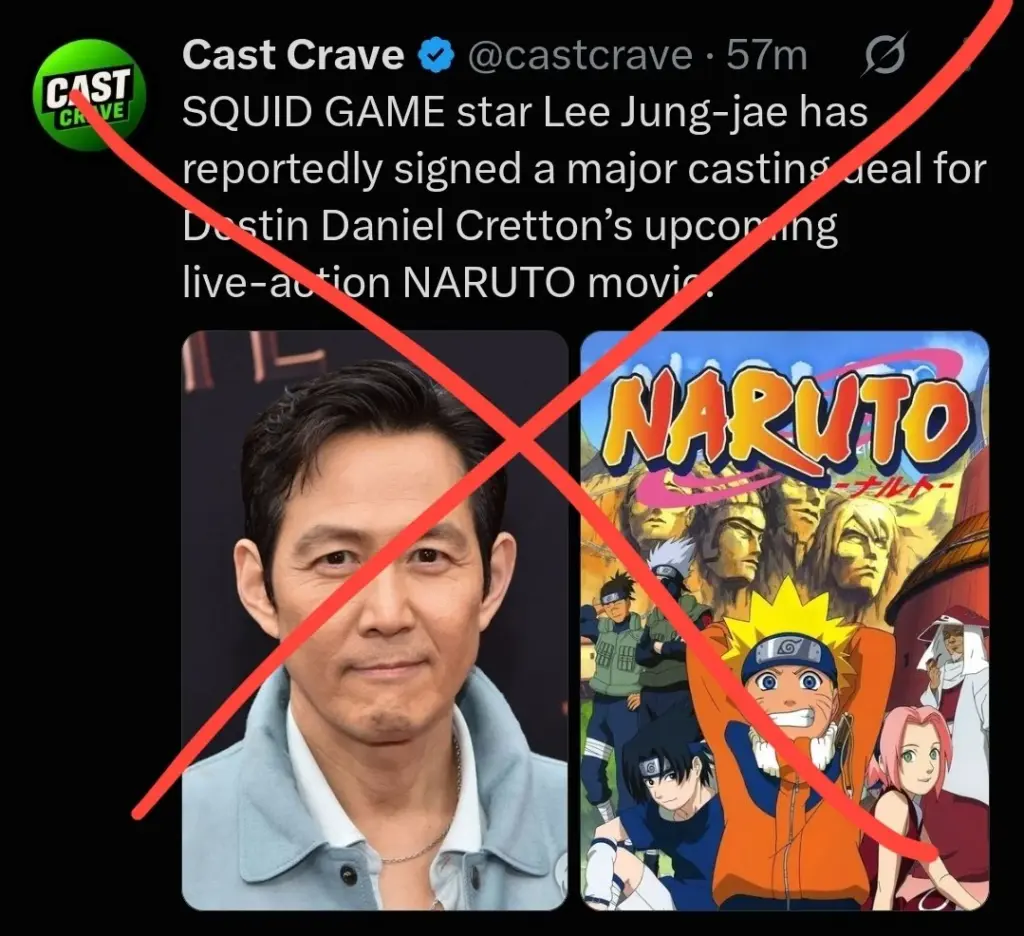
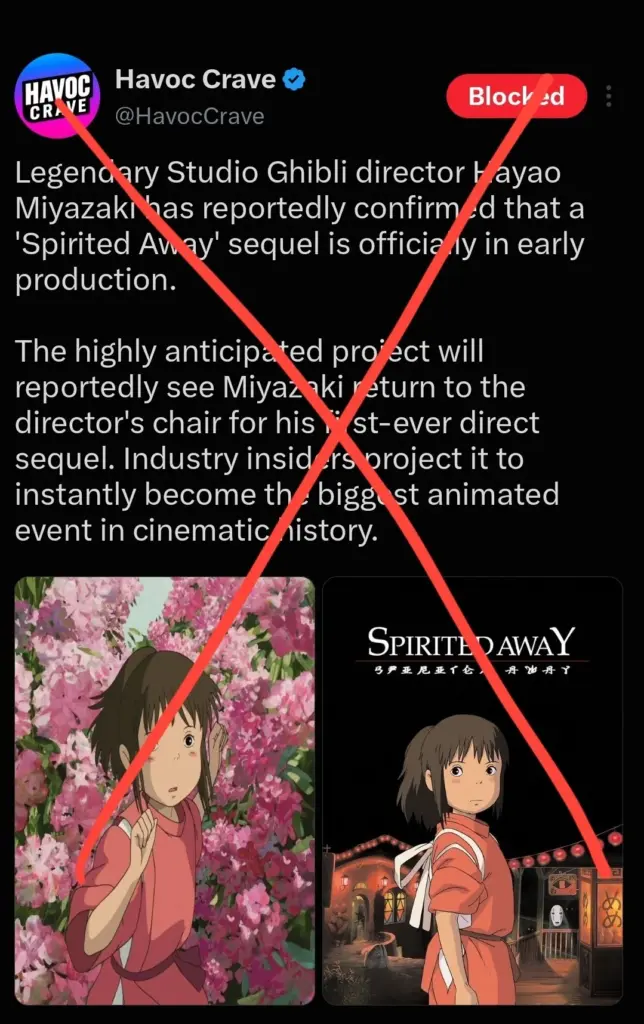
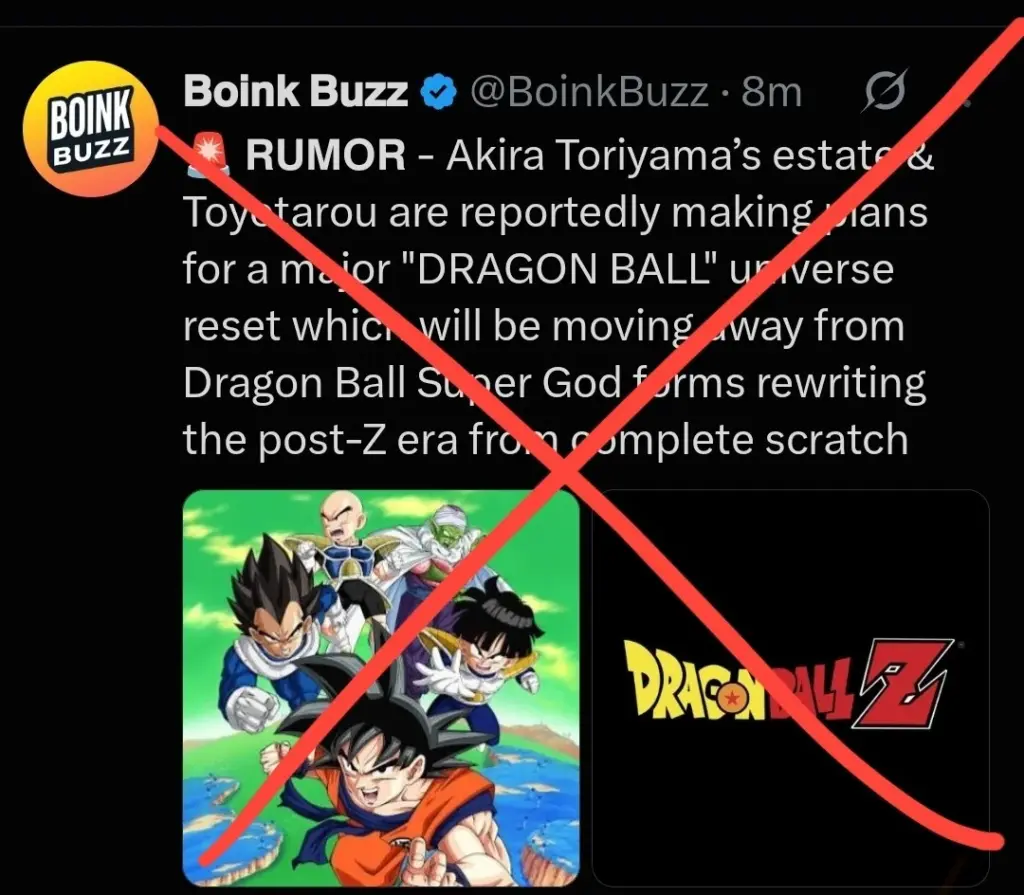
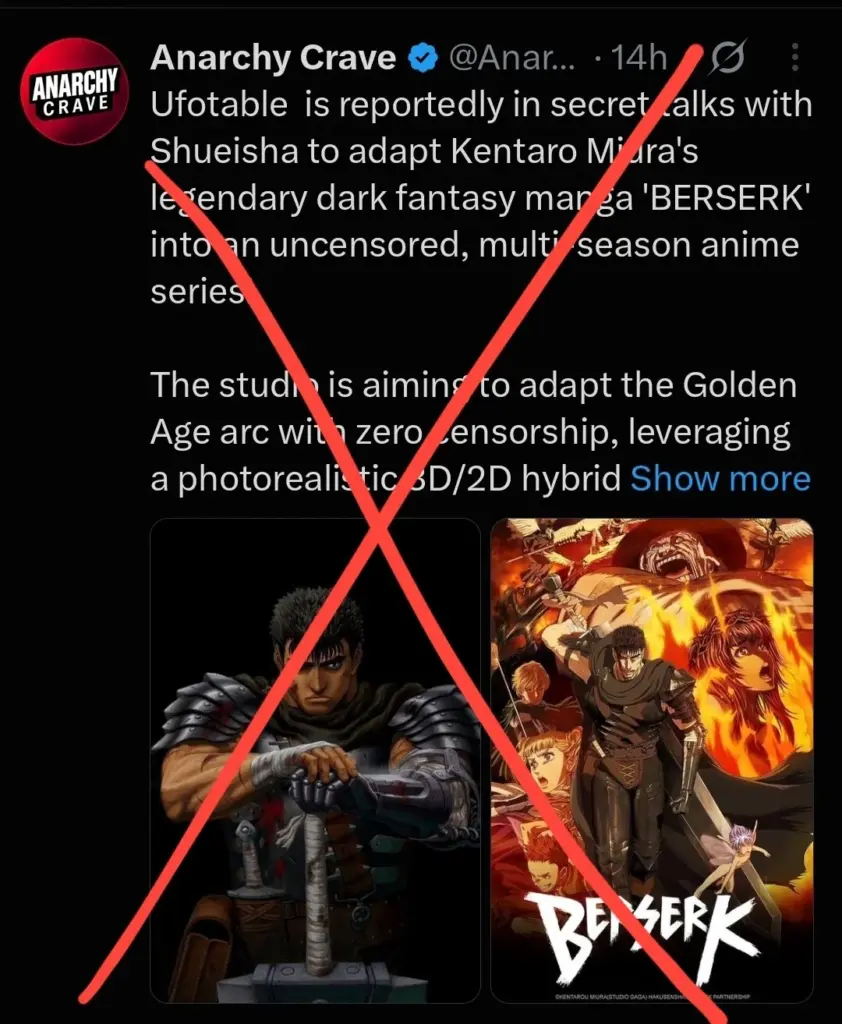
Among the most widely circulated claims are supposed MAPPA remakes of Tokyo Ghoul and Naruto, a MAPPA-produced Hunter × Hunter movie, and several other fictional studio and casting announcements.
What makes this particularly concerning is not simply that these posts exist. Some are presented in the style of legitimate industry exclusives, complete with detailed production information and promotional-looking graphics. Once screenshots and videos are shared without their original context, audiences may have little reason to recognise that the information originated from a parody account.
The issue has also moved beyond anime communities, with similar claims involving Hollywood films, television series and video games appearing across social platforms.
MAPPA’s Rumoured Tokyo Ghoul and Naruto Remakes Reach Millions
One of the most prominent examples concerns a supposed Tokyo Ghoul reboot by Studio MAPPA.
On November 6, 2026, an X account called Havoc Crave published a post claiming that MAPPA was reportedly negotiating to acquire the rights to Tokyo Ghoul and completely reboot the franchise.
The post described a proposed adaptation that would remove non-canon elements from the original anime and offer a complete, uncensored adaptation faithful to Sui Ishida’s manga.
The claim quickly attracted attention, particularly among fans who have long wanted a more faithful adaptation of the series.
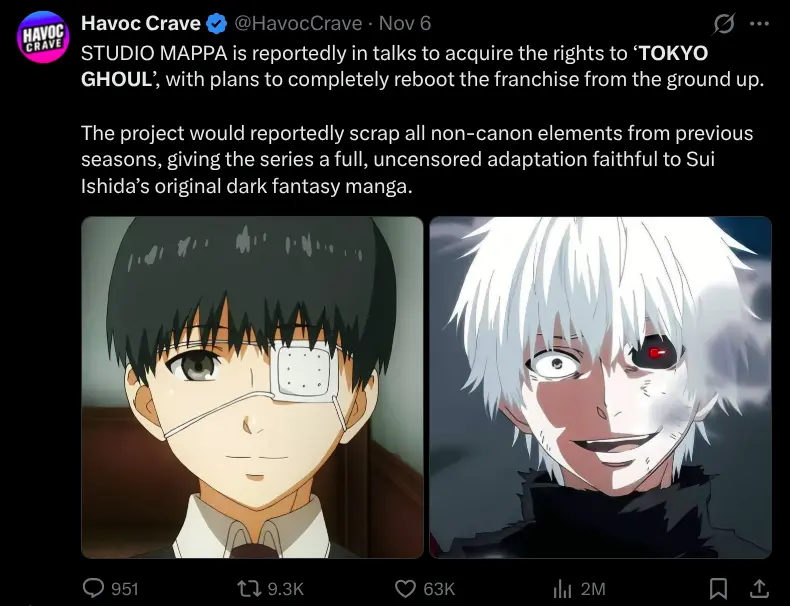
However, there is no official announcement confirming that MAPPA has acquired the rights or is working on a new Tokyo Ghoul anime. An investigation by IndiaTimes also traced the viral claim to Havoc Crave and identified it as satire rather than an actual industry announcement.
An archived capture of the original X post recorded approximately 2.05 million views, demonstrating how far an unsupported announcement can travel.
A similar claim appeared on the same account on November 7, this time involving Naruto.
The post claimed that MAPPA had acquired the animation rights to the franchise and was planning an adult-oriented, uncensored remake with a seasonal release schedule. It also suggested that the adaptation would remove filler and repetitive flashbacks.
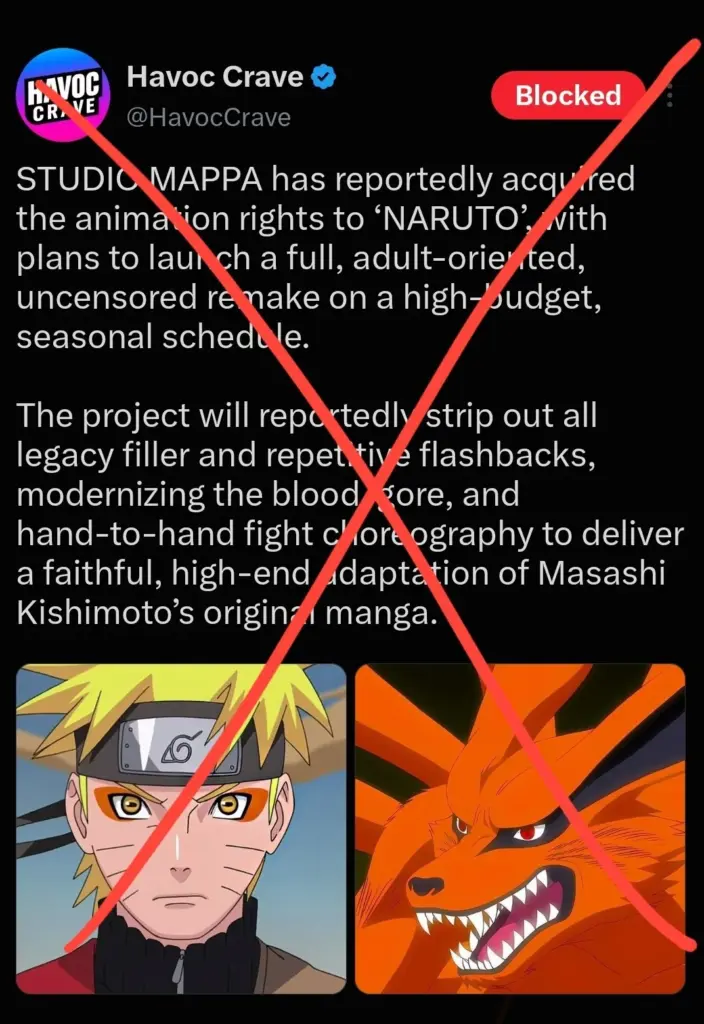
The archived post recorded approximately 612,000 views.
There has been no official announcement supporting this supposed remake. Neither the existence of a popular franchise nor the possibility of a different studio adapting it makes such a claim credible.
These examples demonstrate how familiar franchises and long-standing fan demands can be used to make fabricated announcements particularly attractive to audiences.
Real Announcements Can Also Be Used to Make Fake Details Look Official
Another concerning development is the use of genuine announcements alongside invented information.
A particularly relevant example involves NARUTO: SHADOW RISING.
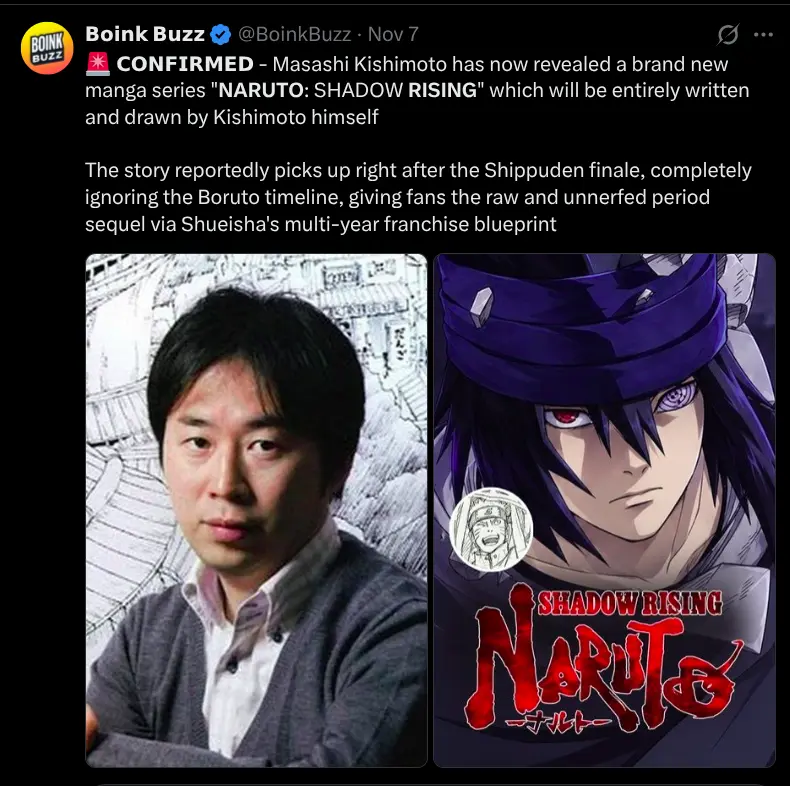
Masashi Kishimoto’s new manga project was genuinely revealed during the Naruto panel at New York Comic Con on October 10, 2026. The official Naruto website and VIZ Media confirmed the announcement, with further information scheduled for Jump Festa 2027.
However, a separate post from Boink Buzz presented additional details as confirmed, claiming that the manga would continue immediately after the Naruto Shippuden finale, completely ignore the Boruto timeline and serve as a multi-year franchise blueprint.
Those details were not established by the official announcement.
The distinction is important. The existence of SHADOW RISING is genuine, but that does not make every storyline or continuity claim circulating alongside the announcement accurate.
The same problem can occur whenever an account takes a real project, attaches invented developments and presents the combined information as breaking news.
Readers who recognise the original announcement may be more inclined to accept the additional details without checking whether they were ever confirmed.
Hunter × Hunter Movie Rumour Travels From X to Japanese Online Communities
The situation is not limited to English-speaking anime communities.
Another recent example involves Hunter × Hunter and a supposed MAPPA-produced feature film adapting the manga’s Succession Contest arc.
Again many pages published a claim suggesting that MAPPA was in preliminary discussions to produce a feature-length movie based on the arc.
The rumour subsequently entered Japanese online discussions. A 5ch discussion thread reproduced the claim, and Japanese manga and anime aggregation websites circulated the topic further.
One Japanese X account, まんふり.net, also shared a link to the discussion.
The story eventually attracted attention from Japanese-language websites investigating the rumour. Two particularly relevant investigations were published by Shinumae and Heavy-Metal.jp.
Both traced the claim to Anarchy Crave and found no official announcement from MAPPA, Shueisha or the relevant rights holders.
The Japanese headline itself was framed as a question:
『HUNTER×HUNTER』王位継承戦、MAPPA制作で長編映画化か
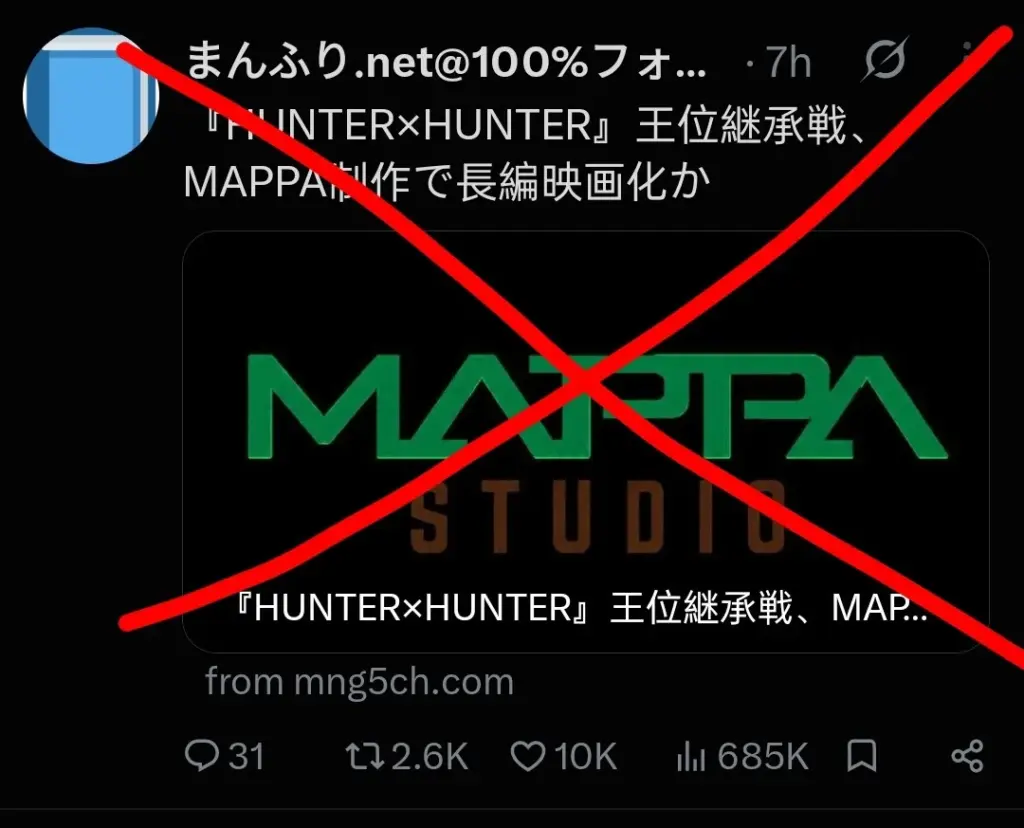
In English, this asks whether the Succession Contest arc could become a MAPPA-produced feature-length film.
Importantly, these Japanese articles were commentary and investigative pieces, not announcements from established anime industry publications.
Some Japanese commenters also questioned the claim, pointing out that the manga’s storyline remains unfinished.
Therefore, it would be inaccurate to suggest that Japanese audiences universally believed the rumour. What the available evidence demonstrates is that an unsupported English-language entertainment claim crossed language barriers and became part of Japanese online discussion.
Several Other Anime and Gaming Franchises Have Also Been Targeted
The MAPPA rumours are only part of the wider activity.
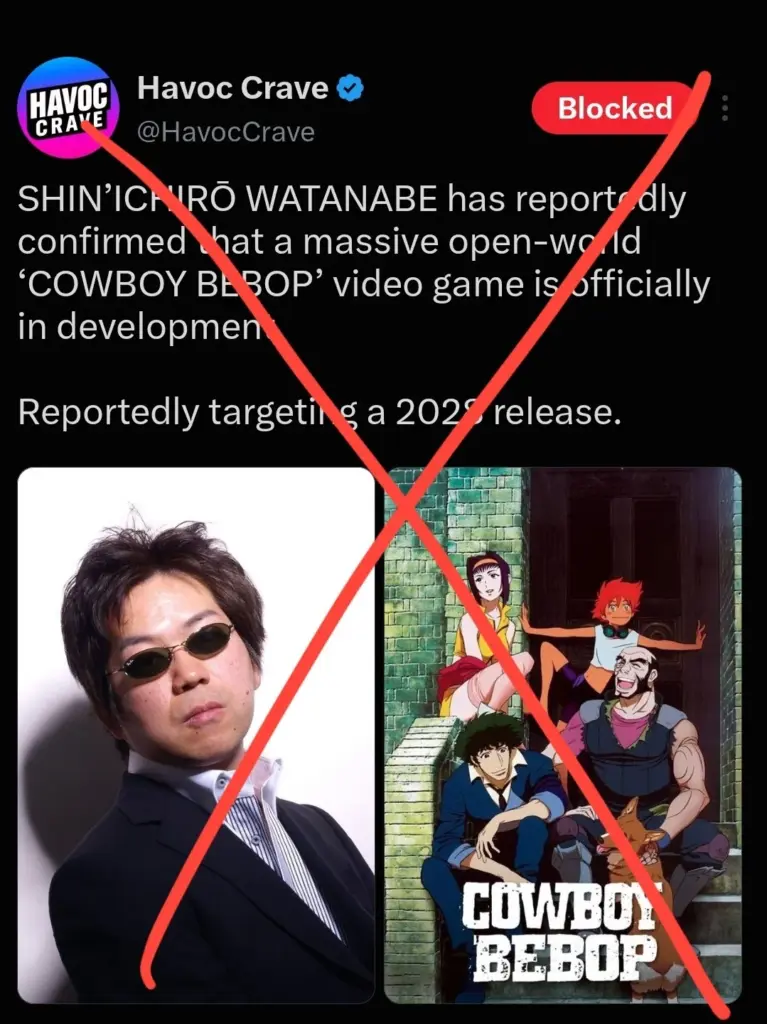
Other examples documented during the investigation include:
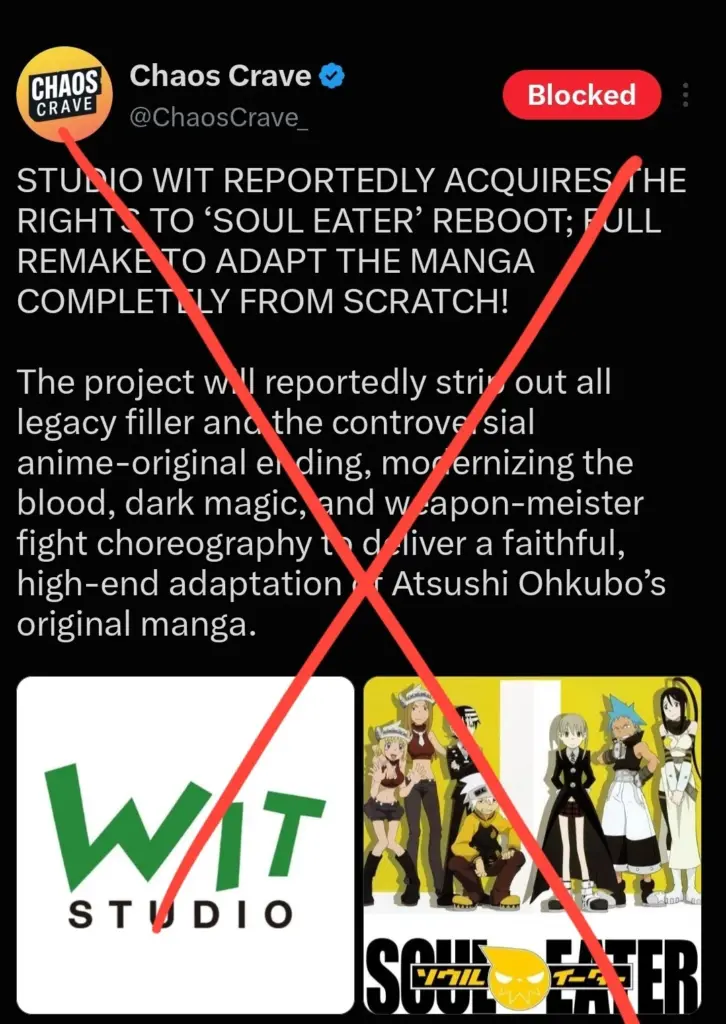
- Soul Eater: Chaos Crave claimed that WIT Studio was acquiring the rights to produce a complete manga-faithful remake. The post received an X Community Note stating that no credible sources or official announcements confirmed the project.
- Death Note: Anarchy Crave circulated a supposed Studio Pierrot political spin-off set decades after Light Yagami’s death. No credible confirmation of the project was found.
- Dragon Ball: Boink Buzz circulated claims about a possible franchise-wide universe reset involving Akira Toriyama’s estate and Toyotarou. The post explicitly described it as a rumour, so it should not be treated as a confirmed announcement.
- Elden Ring: Anarchy Crave claimed that Bandai Namco had announced a prequel game involving the Night of the Black Knives. An X Community Note challenged the claim, pointing out that neither Bandai Namco nor FromSoftware had announced such a project.
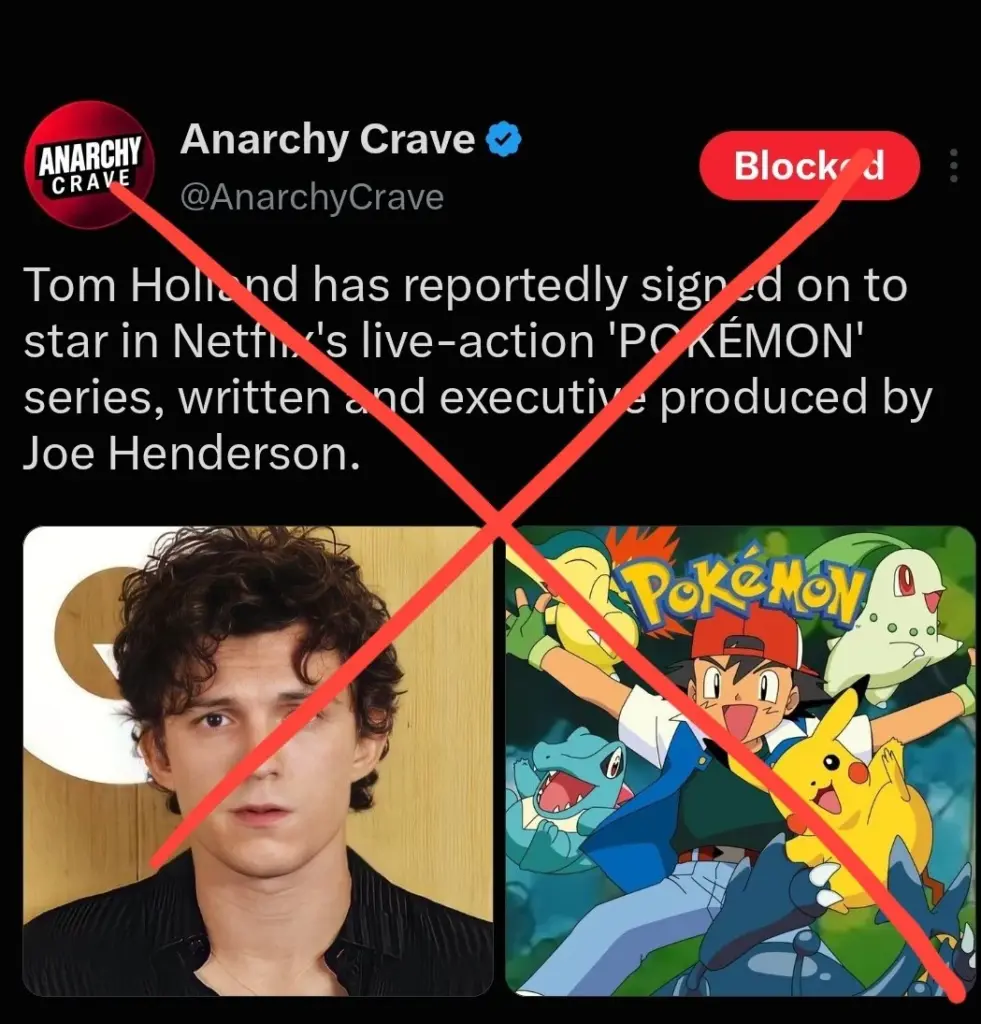
- Pokémon, Tom Holland, & Sadie Sink: The same accounts claimed for the live action Pokémon project where Tom Holland will play Ash Ketchum, and Sadie Sink will play Misty.
These examples are not all identical. Some are presented as parody, while others are explicitly labelled rumours or remain unsupported claims. That distinction matters when reporting them.
However, the recurring use of major entertainment properties, recognisable studios and detailed fictional developments raises a broader question about how easily audiences can mistake social media content for genuine industry reporting.
Instagram Is Helping These Rumours Reach Even More People
The circulation of these claims is not confined to X.
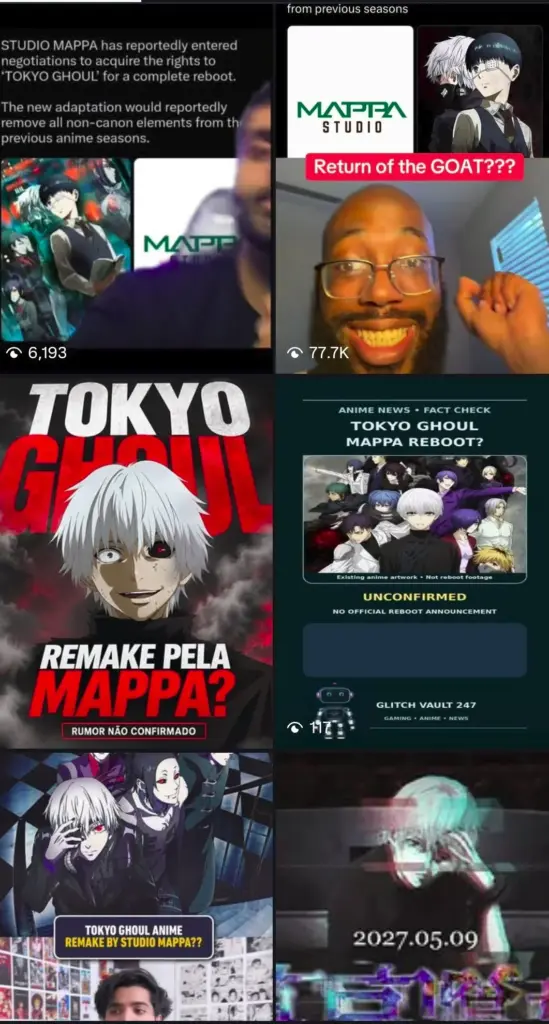
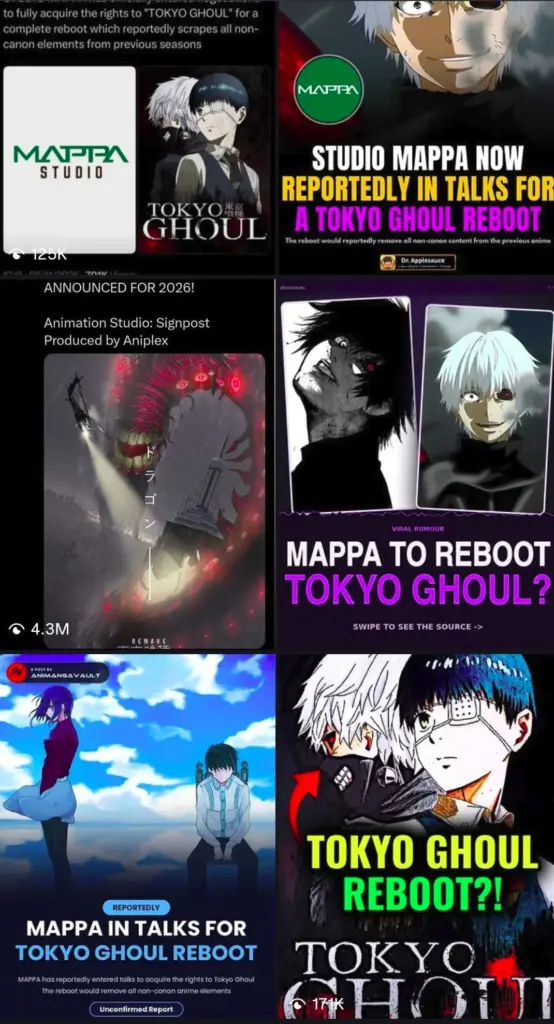
Screenshots shared during Otaku Mantra’s investigation showed multiple Instagram Reels reusing the supposed MAPPA Tokyo Ghoul reboot announcement.
One Reel displayed approximately 4.3 million views, while other visible counters included roughly 171,000, 125,000 and 77,700 views.
Several videos used similar promotional-looking graphics and headlines suggesting that Tokyo Ghoul was returning.
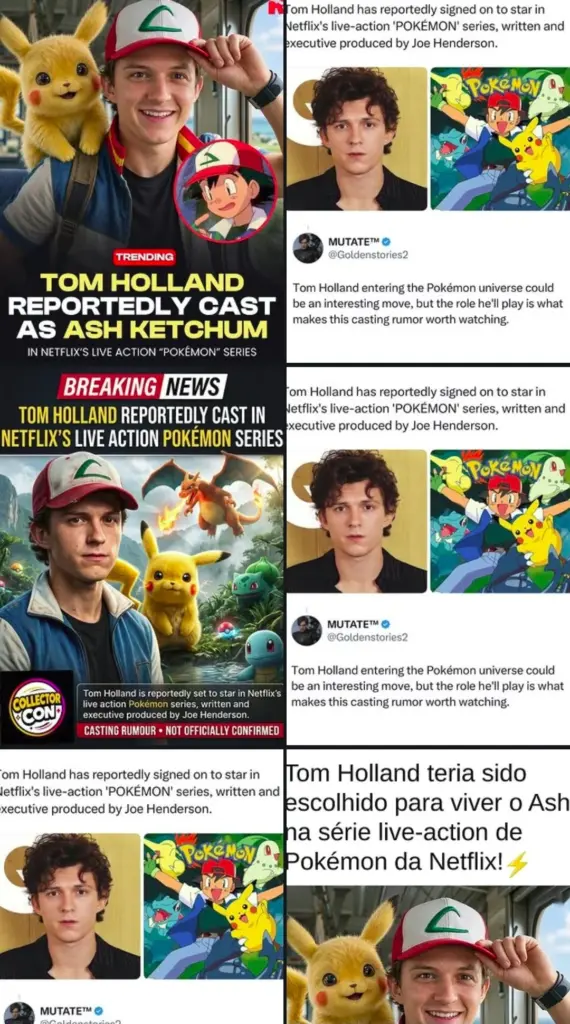
The Tom Holland and Pokémon rumour also appeared in multiple Instagram posts, with some creators using artwork depicting the actor alongside Ash and Pikachu.
These numbers should be understood as displayed view counts in the screenshots, not independently verified unique viewers. Furthermore, not every Reel discussing a rumour necessarily supports it; some may be questioning or debunking the claim.
Nevertheless, the screenshots demonstrate how one social media post can become the basis for numerous separate videos, posts and discussions.
By the time the information reaches another platform, viewers might never encounter the original account, its profile description or any indication that the announcement was fictional.
There is also direct evidence that at least some users mistook these claims for genuine information.
On November 8, an anime user named Yui Kaminari publicly corrected their earlier posts, explaining that they had shared information claiming MAPPA was making Bleach and Tokyo Ghoul remakes. They later discovered that the source was a parody account, described the situation as a false alarm and said they had blocked the account.
This is a particularly useful example because it demonstrates actual confusion rather than relying on view counts alone.
A post receiving two million views does not mean two million people believed it. However, even one documented instance of someone sharing a fabricated announcement as genuine shows why the problem deserves attention.
The Problem With Satire Disclaimers and Blue Checkmarks
Some of the accounts involved in these discussions identify themselves as parody or satirical news accounts.
For example, Havoc Crave’s available profile describes it as an unofficial parody and satirical news account, covering movie rumours, updates and celebrity gossip.
However, the presence of a disclaimer does not necessarily prevent confusion.
A profile description stays attached to the account, not every screenshot or video made from its posts. When someone reposts a headline or promotional graphic without the original account information, the disclaimer may disappear completely.
There is also the issue of blue checkmarks.
Many social media users historically associated a blue verification badge with an established public figure, journalist or organisation.
That assumption is no longer reliable on X.
According to the platform’s own help documentation, a blue checkmark generally indicates an active X Premium subscription and eligibility requirements. It does not establish that an account is an independently verified news organisation or that its published claims have been fact-checked.
X also has specific requirements for parody, fan and commentary accounts. These include using the appropriate PCF label and clearly identifying the account as parody, fan or commentary in its name and profile description.
These requirements exist to reduce confusion about an account’s identity and affiliation.
Even so, a platform label cannot solve every problem when content is copied, cropped and circulated elsewhere without context.
This Is Not Just an Anime Problem
The same accounts have circulated claims involving Hollywood, television, streaming services and video games.
One example involves GTA 6.
Havoc Crave published a claim suggesting that Rockstar Games had confirmed the game would not run on base PlayStation 5 or Xbox Series X|S consoles, supposedly requiring players to upgrade to more powerful hardware.
The post accumulated approximately 2.33 million views in an archived capture. An X Community Note challenged the claim, pointing out that Rockstar’s official platform listings include the base consoles.
Other posts from the same style of accounts have involved properties such as Frozen, The Lord of the Rings and other major entertainment franchises.
Another example involves Tom Holland supposedly joining Netflix’s live-action Pokémon series.
There is a real project behind this particular rumour. In July 2021, Variety reported that Netflix was developing a live-action Pokémon series, with Joe Henderson attached as writer and executive producer.
However, the original report described the project as being in early development and did not announce Tom Holland or any other cast member.
The subsequent casting claim therefore adds an unsupported development to a real but much older entertainment report.
This illustrates how fabricated entertainment news can extend beyond one fandom and become part of a much wider information problem.
How Fake News Accounts Can Build Credibility Before Spreading False Information
Perhaps the most important part of this investigation is that the techniques involved are not entirely new.
The practice of building an online audience before distributing misleading information has been documented in research on social media disinformation for years.
A 2021 research paper titled How Does Fake News Spread? Understanding Pathways of Disinformation Spread Through APIs examined how actors can establish themselves within existing social media communities before distributing misleading content.
The researchers identified several stages involved in spreading disinformation, including network creation, audience profiling, content generation and information dissemination.
One particularly relevant finding concerns the use of legitimate content to establish an account’s reputation.
The research discusses how accounts can share ordinary content, breaking news and other legitimate material to appear more credible and gain the attention and trust of genuine users before distributing disinformation.
This is remarkably close to the behaviour that concerns many social media users today.
An account does not necessarily need to publish fabricated stories forever. It can build an audience, share genuine information and subsequently introduce misleading claims to an audience that has already become accustomed to its content.
Recycling old news to make an account appear legitimate
Another documented technique involves republishing genuine but outdated news and presenting it as a current development.
In June 2019, cybersecurity research company Recorded Future identified a social media influence operation called Fishwrap.
The operation involved more than 215 accounts that systematically reused images and reports from previous incidents, presenting them as breaking news.
For example, images of student protests in Chile from 2016 were reused to support a newer misleading report. Other accounts recirculated genuine news about the November 2015 Paris terrorist attacks in March 2019, presenting the incidents as though they were happening again.
The links sometimes led directly to the original historical reporting, meaning the underlying event was real, but its presentation as new information was misleading.
The investigation also raised the possibility that some accounts were being maintained to establish an online history before being used for future influence activities.
This demonstrates an important distinction: Real information can still be misleading when its date, context or original meaning is deliberately removed.
When genuine reporting is used to support misinformation
A 2025 study published in Nature Human Behaviour, titled Using co-sharing to identify use of mainstream news for promoting potentially misleading narratives, examined how authentic articles from reliable news organisations can be repurposed by people who also share fake news.
The researchers found that some legitimate mainstream news articles were disproportionately shared by users with a history of sharing fake news. These articles also carried existing misinformation narratives more frequently than comparable articles that were not circulated in the same way.
The findings suggest that genuine reporting can be strategically reused to strengthen the reach and persuasiveness of misleading narratives.
Separately, guidance published by the US Cybersecurity and Infrastructure Security Agency (CISA) describes how disinformation actors can begin by sharing entertaining or non-controversial posts to gain insider status and build an audience before attempting further manipulation.
These findings provide useful context for understanding why an account might combine authentic information, older news and fabricated announcements.
However, they do not establish that every account currently posting fake anime news is deliberately following this strategy.
During this investigation, a complete historical audit of the posting timelines of Havoc Crave, Anarchy Crave and Chaos Crave was not established. Therefore, it would be premature to accuse these specific accounts of systematically recycling old news to build credibility.
What can be established is that these techniques have been documented in wider disinformation research, and that combining real information with unsupported claims can make misleading content more convincing.
How Anime Fans Can Avoid Falling for Fake Announcements
With fabricated announcements becoming increasingly convincing, readers need to be more careful about the sources they trust.
A large following, a blue checkmark or an impressive-looking promotional image is not evidence that an announcement is genuine.
Before sharing an anime announcement, readers should:
- Check official announcements. Look for confirmation from the actual animation studio, publisher, production committee, franchise website or rights holder.
- Trace the original source. Do not assume a claim is credible simply because multiple accounts have reposted it. Find the earliest identifiable source.
- Check publication dates. An authentic article from several years ago does not establish that the same development is happening today.
- Separate confirmed information from speculation. A real anime announcement does not automatically validate additional claims about its cast, release date, studio or storyline.
- Look beyond profile badges. A paid verification badge does not establish journalistic credibility.
- Be cautious with screenshots. Check the original post and its surrounding context, particularly when an announcement contains unusually detailed information.
- Follow Reliable News Outlets: News outlets like Anime News Network, MyAnimeList, Otaku Mantra, Crunchyroll News, Anime Corner, Anime Trending, etc., provide accurate news with confirmed sources.
Most importantly, readers should avoid sharing claims simply because they are exciting or something they desperately want to happen.
A long-awaited remake, sequel or adaptation deserves proper confirmation, not another fabricated announcement.
The Anime Community Deserves Better Than Engagement-Driven Fake News
The anime industry already has a large number of genuine announcements, production updates and important stories that deserve attention.
From new adaptations and studio collaborations to working conditions, industry developments and creator announcements, there is no shortage of real news worth covering.
The growing circulation of fabricated entertainment stories makes it increasingly difficult for readers to distinguish legitimate reporting from fictional announcements designed to attract attention.

Satire itself is not the problem. Parody accounts can exist, provided their identity and intentions are clearly communicated. The bigger concern is how fabricated claims are presented, copied and circulated without their original context, sometimes reaching audiences who have no idea where the information originated.
There is also a responsibility on content creators and entertainment pages to check what they publish before presenting it as breaking news.
An announcement does not become genuine because thousands of people have shared it. Nor does an account become a reliable news source simply because it has published a few accurate stories.
For anime fans, the most important thing is to verify individual claims rather than blindly trusting accounts based on their popularity or previous posts.
The community deserves accurate reporting, transparent sourcing and genuine industry news. Not fabricated announcements disguised as exclusive entertainment scoops. Bookmark Otaku Mantra for more amazing content!