Making anime with CG instead of hand-drawn animation isn’t necessarily progress. For director Kenji Kamiyama, the real challenge is finding a visual approach that can express what he wants to show, regardless of the technology involved. The director is now putting that philosophy to the test with his upcoming Mobile Suit Gundam RG XARX-ZERO, which he says is exploring what he currently considers the “optimal solution” for visual expression.
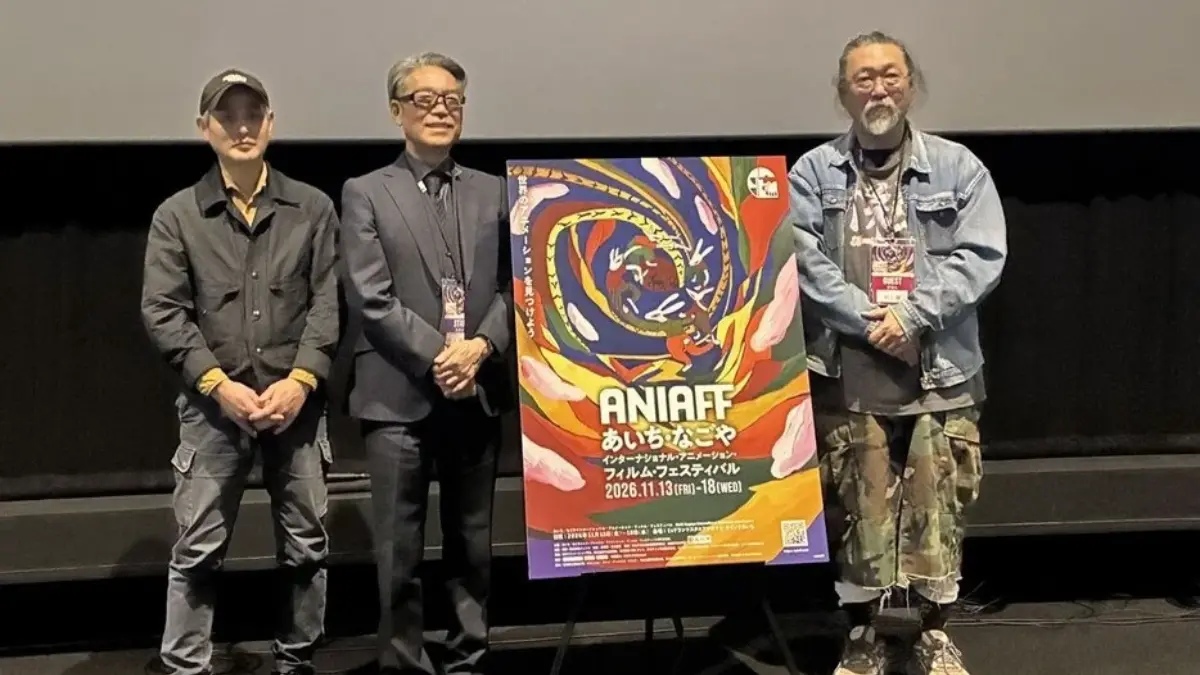
Kamiyama discussed the project, his experience working on Ghost in the Shell: Stand Alone Complex and Star Wars, and the difficulties of bringing major Hollywood franchises into Japanese animation during a special all-night Titscreening at the second Aichi Nagoya International Animation Film Festival (ANIAFF) on November 14.
The event, titled “Kenji Kamiyama Director Special,” featured screenings of his work and a discussion with the director. Screenwriter Miho Sakai, who worked on Star Wars: Visions – The Ninth Jedi, also joined the event as a special guest.
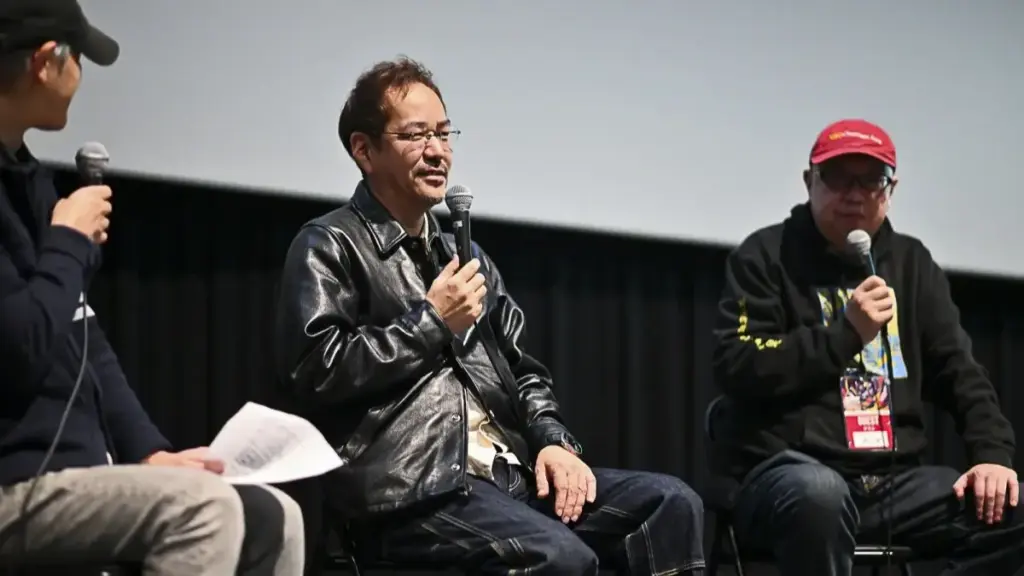
Kenji Kamiyama Thought Ghost in the Shell: Stand Alone Complex Might Be His Last Chance as a Director
Kamiyama looked back on Ghost in the Shell: Stand Alone Complex, the series that became his major breakthrough as a director. At the time, he approached the project with the thought that he might never get another opportunity to direct after it.
The production was not exactly smooth sailing. Kamiyama recalled that there was a possibility that the team might not even be allowed to use the Ghost in the Shell name and setting. Although original creator Masamune Shirow supported the project, people around the production had plenty of objections to its direction.
Some criticised it for being uninteresting or not feeling enough like Ghost in the Shell.
Eventually, Kamiyama decided he could no longer keep adjusting his work to satisfy everyone. He explained:
“Eventually, I decided to stop listening to what other people were saying. I thought that even if I got fired for it, that would be fine. In the end, I survived.”
The gamble paid off. Once the series became a hit, attention came pouring in. Television crews started visiting the studio, and journalists even travelled from Spain to interview the team. Kamiyama said the production had initially been something they were quietly making in a corner of the studio, so watching it suddenly attract international attention felt surreal.

One particular encounter in New York made the change especially clear.
While travelling to the city for his next project, Kamiyama was asked about his occupation during immigration checks. He answered that he made anime in Japan. The immigration officer then asked him whether he knew Ghost in the Shell.
Kamiyama replied, “Thank you. I’m the one who made it.” The officer subsequently asked him for an autograph.
It’s quite a turnaround for a director who once thought the project might end his career.
The Lord of the Rings: The War of the Rohirrim Required 20,000 Horses
The first film discussed during the all-night screening was The Lord of the Rings: The War of the Rohirrim, Kamiyama’s animated feature set roughly 200 years before the events of Peter Jackson’s The Lord of the Rings live-action trilogy.
Kamiyama said he had enjoyed making the film and was grateful to see it return to the big screen, particularly because it had struggled to attract a large audience when it was originally released.
The project began after Warner Bros. approached him with an idea: adapt a major Hollywood franchise using the visual style of Japanese animation. Kamiyama was already a fan of The Lord of the Rings, so the opportunity was exciting. However, he also had concerns about building a film around a story that did not feature the familiar characters audiences associated with the franchise.
There was another major challenge. The source material was only around eight pages long, but the team had to turn it into a feature-length film.
Then came the production demands.
Kamiyama jokingly recalled the scale of the challenge, saying, “The schedule and budget… Are we supposed to have 20,000 horses appear in this thing?” He admitted that completing the film was genuinely difficult.
One of the biggest challenges was bringing scenes featuring huge numbers of horses to life. Rather than relying on a single technique, the production combined several methods. The team used live-action footage as a basis for creating CG, which was then redrawn by hand.
With a production period of roughly two years, Kamiyama adopted a practical approach: use whatever tools are necessary to finish the film. The production brought together different techniques instead of limiting itself to one animation method.
Star Wars Was the Reason Kamiyama Wanted to Become a Film Director
For Kamiyama, Star Wars was more than another famous film franchise. It was the reason he wanted to become a film director in the first place.
“I watched Star Wars and decided I wanted to become a film director. That’s how I got here,” he said.
Over the years, Kamiyama has worked with different filmmaking techniques, including 3DCG and motion capture. He described the last decade of his career as feeling almost like he had been competing in the sport of being a film director.

However, his interest has never been limited to whether a particular image is created through animation or live-action filmmaking.
Instead, he wants to express certain phenomena and make things that cannot normally be seen understandable through images. He believes a director’s job is to take an idea and communicate it to other people in a way they can understand.
For that reason, he does not consider the method of filmmaking itself to be the most important thing. What matters is finding the right way to communicate what he wants to show.
That philosophy has also shaped his work with Star Wars.
Why Miho Sakai Wrote The Ninth Jedi Instead of Kamiyama
Kamiyama’s work on The Lord of the Rings: The War of the Rohirrim overlapped with the production of Star Wars: Visions – The Ninth Jedi, which is available worldwide on Disney+.
Although Kamiyama directed the project, screenwriter Miho Sakai handled its script.
Sakai explained that he originally thought Kamiyama would want to write the screenplay himself and perhaps should be the one to do it. However, with the director already occupied with The War of the Rohirrim, the writing assignment eventually came to Sakai.
Kamiyama was glad that he had joined the project, explaining that if he had written the script alone, it probably would have become too heavy. He also appreciated how Sakai’s extensive knowledge of science fiction contributed to the story.
There was, however, one unexpected difficulty when working with Lucasfilm.
Kamiyama recalled that he had initially been told he could create the project freely. Once it became part of a series, however, a set of specific rules suddenly came into play.
“They told me I could make it freely at first, but when it became a series, all these unique rules suddenly appeared, and Lucasfilm got angry with me,” he joked.
Despite those occasional disagreements, Kamiyama said working with the people behind the franchise that inspired his career was genuinely rewarding. He also wanted to see whether the filmmaking approach he had developed over the years would hold up when working with the creators he had admired since childhood.
Sakai offered his own perspective on why international studios trust Kamiyama. He described the director as someone who never compromises on his vision but also never abandons a project.
According to Sakai, Kamiyama listens to criticism, stays composed when people disagree with him, and does not run away from difficult situations. That combination, he suggested, is one of the reasons people enjoy working with him.
Kenji Kamiyama Questions Whether Anime Has Been Using CG the Right Way
Towards the end of the discussion, the conversation turned to how Japanese animation has changed as it has found larger audiences around the world.
Kamiyama pointed out that a younger generation of Japanese creators has grown up watching Japanese dramas and listening to Japanese music. His own generation, by comparison, was heavily influenced by Western films.
He wondered whether the international success of anime created without relying on foreign co-productions might suggest that older creators had been approaching things the wrong way.

He also raised an important point about the techniques audiences and studios expect from Japanese animation. Despite the growth of CG production, hand-drawn animation remains highly sought after around the world.
For Kamiyama, simply using CG as a substitute for traditional animation is not enough to create something genuinely new.
He explained that when studios try to produce high-quality CG, the costs can eventually become comparable to those of making anime. The process can also become just as complicated, or even more complicated, than hand-drawn production, without necessarily surpassing what traditional animation can achieve.
He believes a real breakthrough will require a fundamentally different approach rather than simply recreating the same results with CG.
“Even if we make something similar with CG, the voices saying that’s not what they want are getting louder. And when you try to create high-quality CG, it ends up costing as much as making anime. You’re doing something just as complicated as hand-drawn animation, or even more complicated, but you still can’t surpass it. I don’t think there will be a breakthrough unless we take a completely different approach instead of using CG as a substitute.”
New Gundam Project Is Exploring What Kamiyama Calls the “Optimal Solution”
These ideas are particularly relevant to Kamiyama’s current work on Mobile Suit Gundam RG XARX-ZERO. During the discussion, he revealed that the project is allowing him to experiment with a different approach to visual expression.
He described the work as something that isn’t necessarily the culmination of everything he has done so far, but represents what he currently believes could be the best solution.
“What we’re trying this time isn’t the culmination of everything, but we’re doing what I think is the optimal solution. Whether people will praise it remains to be seen, but I’m really looking forward to showing it to everyone.”
Kamiyama also spoke about the possibilities of AI in animation, although he admitted that he has reservations about the technology.
He said that CG alone had not been able to reach the results he was looking for, but believes that the way AI is used could potentially lead to something that goes beyond CG.
His comments do not confirm that AI is being used in Mobile Suit Gundam RG XARX-ZERO. Rather, they reflect his broader interest in finding new tools and methods that can expand what animation is capable of expressing.
For a director who has worked across Ghost in the Shell, The Lord of the Rings, and Star Wars, the challenge remains the same: the technology should serve the image and the idea, not the other way around. Bookmark Otaku Mantra for more updates!
The second Aichi Nagoya International Animation Film Festival is running until November 18, 2026, with screenings and events taking place at venues across Nagoya, including Midland Square Cinema 2.
Source: Oricon