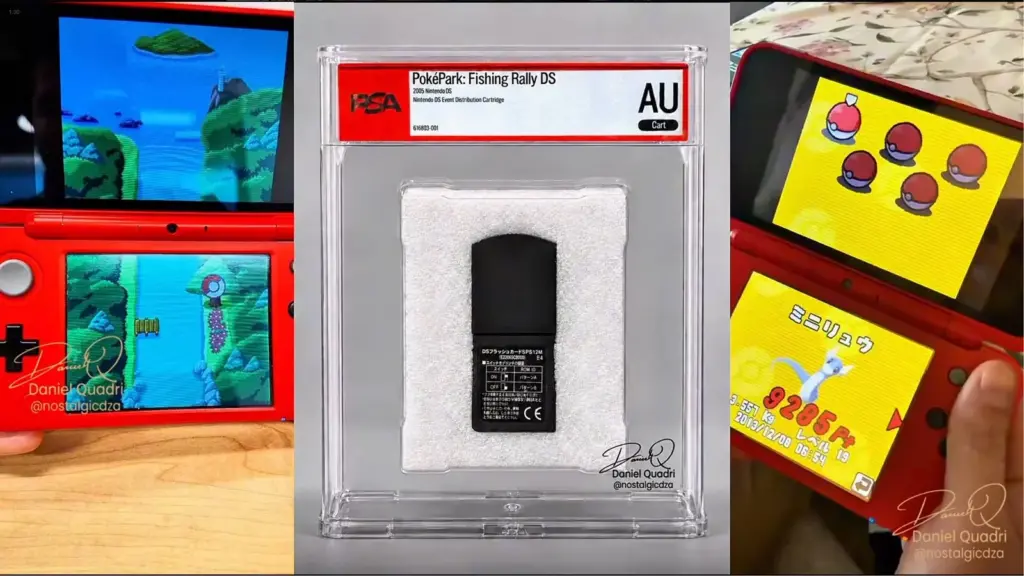
A Pokémon game that fans believed had disappeared forever has finally resurfaced after nearly 20 years. PokéPark: Fishing Rally DS, a limited-time fishing game that Nintendo DS owners could only download at special Pokémon events in 2005, has turned up in the collection of a Pokémon fan and retro game enthusiast named Daniel Quadri. He has even demonstrated that the game still works, including its ability to transfer the experience to other Nintendo DS systems.
However, what should have been an exciting discovery for Pokémon fans and video game preservationists has quickly turned into a debate. After Quadri sent the rare cartridge to Professional Sports Authenticator (PSA) for authentication and grading, the company sealed it inside a protective plastic case. While the process confirmed that the game was genuine, it also made the cartridge inaccessible for ordinary play.
Now, fans are questioning why the discovery didn’t lead to a digital preservation effort before the collector sealed the game. Many are asking Quadri to release a ROM copy so that people can finally experience a game that disappeared from public access two decades ago.
PokéPark: Fishing Rally DS Was a Limited-Time Pokémon Game From 2005
Before getting into the controversy, it’s worth understanding why this discovery matters so much.
PokéPark: Fishing Rally DS, also known by its Japanese name PokéPark: Tsuri Taikai DS, was a special fishing minigame that Pokémon fans could experience during limited-time events in Japan.
The game originally appeared at Pokémon The Park 2005, commonly known as PokéPark, a temporary Pokémon-themed attraction in Nagoya, Japan. It was also associated with Pokémon events such as Pokémon Festa 2005. PSA’s account of the discovery additionally confirms that the game appeared in Taiwan during summer 2006.
Unlike conventional Nintendo DS games, PokéPark: Fishing Rally DS never received a commercial retail release. Visitors could download it for free through Nintendo DS Download Play stations installed at participating venues.
The experience was relatively simple but offered something different from the usual Pokémon adventures. Players used Poké Balls as bait to catch Pokémon through a fishing minigame, earning points based on their catches. The game also featured different fishing locations and a scoring system that allowed players to compete through event and ranking activities.
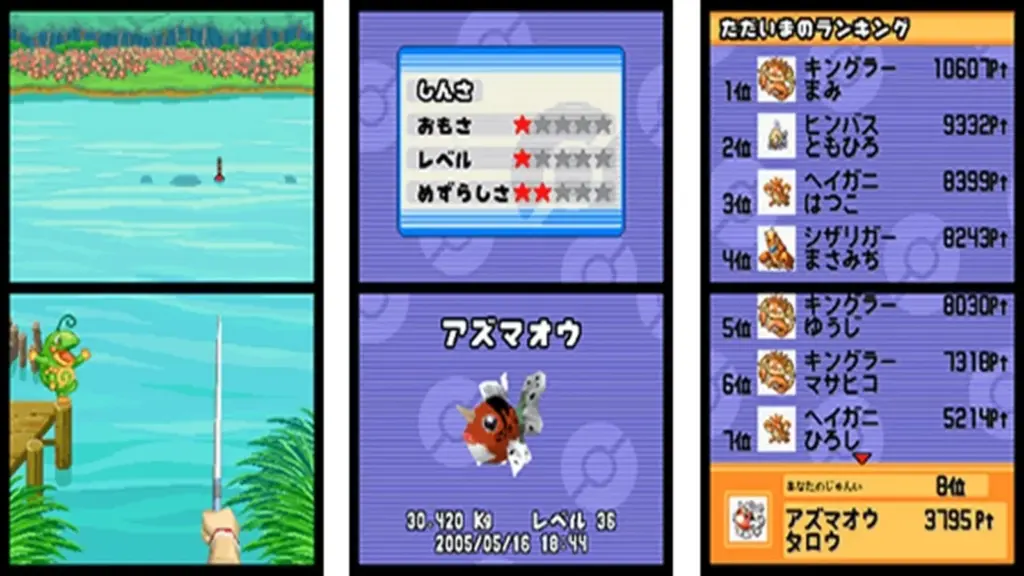
Children visiting PokéPark could download the game while waiting for attractions and enjoy a little Pokémon fishing without purchasing anything.
However, there was one major limitation that eventually made the game extremely difficult to preserve.
The downloaded game automatically deleted itself after 12 hours or whenever players switched off or reset their Nintendo DS.
This meant that players couldn’t simply take the game home and continue playing it whenever they wanted. Once the temporary download disappeared, they needed another opportunity to access the distribution system.
Because Nintendo and The Pokémon Company never released the game commercially or made its software publicly available, PokéPark: Fishing Rally DS gradually became one of the more unusual examples of lost Pokémon media.
Pokémon Collector Daniel Quadri Discovers a Working Copy of the Lost Game
For years, Pokémon fans could only rely on old photographs, personal memories and limited footage to understand what the game actually offered.
There were also occasional discoveries that created hope among preservationists without providing a confirmed playable copy.
In July 2026, an unusual Nintendo DS cartridge associated with the old PokéPark game appeared on eBay. The listing attracted considerable attention, but the cartridge appeared to relate to the game’s distribution or leaderboard system rather than containing the fully playable fishing minigame.
That discovery didn’t solve the mystery. Now, however, Daniel Quadri has provided something considerably more important.
The Pokémon collector contacted gaming publication IGN and supplied videos demonstrating that his cartridge could actually run PokéPark: Fishing Rally DS on a Nintendo DS.
He also showed the publication how the cartridge could distribute the game to other DS systems through the handheld’s Download Play feature.
This was particularly significant because it provided evidence that the complete game still existed in a working form rather than merely surviving through old promotional material or development hardware.
Quadri hasn’t revealed exactly how he obtained the cartridge. However, his collection includes various pieces of PokéPark memorabilia, including old magazines, promotional brochures and merchandise from the attraction.
For someone who has spent years collecting Pokémon history, discovering a game that many fans assumed they would never play again was understandably emotional.
Speaking to IGN, Quadri explained that rediscovering the game allowed him to experience something that Pokémon fans had spent years wondering about.
He also described the experience of catching a Gyarados again after turning on his Nintendo DS, briefly recreating the feeling of visiting PokéPark in 2005.
PSA Authenticates the Pokémon Fishing Game but Seals It Inside a Protective Case
Quadri eventually approached Professional Sports Authenticator, commonly known as PSA, to authenticate and grade the rare cartridge.
PSA specialises in authenticating and grading collectibles, including trading cards and video games. Its involvement gave the discovery another important level of credibility.
Claire Shelton, who heads PSA’s video game division, personally examined and played the game before the company completed its authentication process.
In her account of the experience, Shelton revealed that she spent approximately two hours playing the game with its owner in early September 2026.
She explored its fishing locations, caught different Pokémon and experienced its scoring system firsthand. Her favourite catch was a Relicanth, while she also enjoyed spotting Pokémon such as Psyduck, Politoed and Slowbro appearing in the backgrounds.
Shelton managed to achieve a score of approximately 25,000 points, although she joked that this probably wouldn’t have been enough to appear on the original PokéPark high-score leaderboard.
Following the examination, PSA confirmed the cartridge’s authenticity and encapsulated it inside a transparent protective case.
PSA described its involvement as an opportunity to document and preserve a rare piece of Pokémon history.
However, the decision to seal the cartridge created an unexpected problem for the wider gaming community.
Pokémon Fans Want the Collector to Open the PSA Case and Release the ROM
The biggest disagreement isn’t about whether Quadri discovered a genuine copy of the game. PSA has already authenticated it, and the playable footage provides further evidence that the discovery is real.
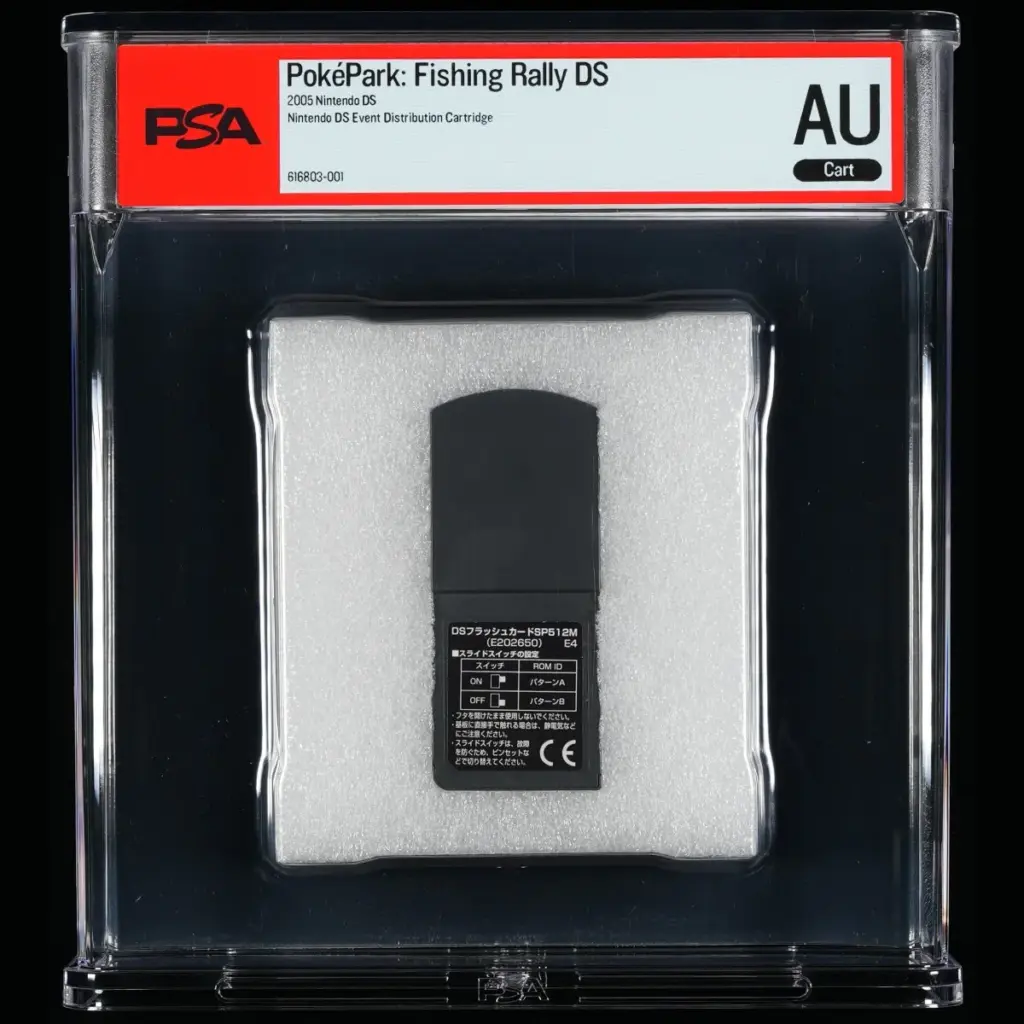
The controversy is about what happened next.
By placing the cartridge inside PSA’s sealed protective case, Quadri effectively removed it from ordinary use. Players cannot insert the cartridge into a Nintendo DS while it remains encapsulated.
Opening the case would allow someone to access the cartridge again, but doing so would compromise its grading and sealed collectible status.
For collectors, maintaining the original physical item in authenticated condition has obvious value. But for people interested in video game preservation, protecting the cartridge alone doesn’t necessarily preserve the experience stored inside it.
That’s why many Pokémon fans wanted the owner to create a digital backup of the game before sending the physical cartridge for grading.
A ROM dump would allow preservationists to archive the software and potentially make it playable through compatible hardware or emulation, subject to the relevant copyright restrictions.
One X user, Anthony (@KirbyCheatFurby), openly criticised the decision to seal the cartridge without first making the game accessible to everyone.
He wrote:
“Instead of making it so we can all play the ROM by dumping its contents online, they got it put in a fucking PSA case.”
In another post, Anthony directly asked Quadri to:
“Crack that slab open and dump the ROM.”
He also argued that the collector could simply purchase another protective case after preserving the software.
The criticism quickly spread among people who had hoped the discovery would finally bring the lost game back to the wider Pokémon community.
Fans on Reddit Call the PSA Case a ‘Digital Grave’ for the Lost Pokémon Game
The reaction on Reddit has been particularly interesting, with several commenters questioning whether authenticating a physical collectible should take priority over preserving the software itself.
One commenter criticised the announcement, writing:
“And no word about actual preservation, this is just an ad for a scummy grading company, disgusting.”
Another user responded sarcastically to the idea that PSA had preserved the game:
“The game has been preserved. In a PSA slab.”
Someone else continued the joke:
“Preserved, as in entombed 😭”
The discussion also produced comments questioning the entire practice of grading video games.
One Reddit user wrote:
“I cannot fucking stand grading for video games. So monumentally stupid and an incredible waste.”
Other commenters focused specifically on the fact that people might never get another opportunity to play this particular Pokémon game.
In a separate discussion on the r/PokePark subreddit, one fan asked whether Quadri had dumped the ROM before sending the cartridge to PSA.
Another commenter replied that, to their knowledge, he hadn’t released or announced a ROM dump.
One particularly frustrated user questioned why someone would obtain such an important piece of lost media without making it accessible to others, asking whether the collector even cared about game preservation.
However, not everyone agreed with the criticism.
Some Reddit users argued that an individual collector doesn’t automatically have an obligation to make their private collection available to the public.
One commenter asked:
“Why would some collector have to preserve this for anyone?”
Another replied:
“They don’t owe you anything.”
This disagreement highlights two very different ideas about what it means to preserve video game history.
For one side, preserving the original physical cartridge and proving its authenticity matters most. For the other, preserving the actual software matters more because future generations should be able to experience the game rather than simply look at its physical remains.
Daniel Quadri Has Expressed Interest in Helping Preserve the Game
Interestingly, the collector himself hasn’t dismissed the importance of preservation.
In his conversation with IGN, Quadri expressed interest in helping preserve PokéPark: Fishing Rally DS and sharing its file with other Nintendo DS systems.
He also explained why the discovery meant so much to him.
“Preserving a game like this means so much to me,” he said.
That statement is important because it suggests that Quadri recognises the historical significance of the software beyond its value as a rare collectible.
However, there is still a difference between expressing an interest in preservation and announcing a public software release.
As of November 15, 2026, no publicly available ROM dump of this newly discovered playable copy has been announced. The cartridge remains inside its PSA case, and Quadri hasn’t announced a release date or a confirmed method for making the software accessible.
The situation also raises questions about how collectors, preservationists and copyright holders can work together when someone discovers a rare piece of gaming history.
A physical cartridge can establish that a game existed, but a properly preserved digital copy can ensure that future researchers and players don’t depend entirely on one privately owned object.
A Rare Pokémon Discovery That Raises a Bigger Question About Game Preservation
The discovery of PokéPark: Fishing Rally DS is already an important moment for Pokémon history.
For almost two decades, fans had very little chance of experiencing a game that existed only through temporary downloads at special events. Daniel Quadri’s discovery finally provides evidence of a working copy, along with an opportunity to document how the original experience worked.
But the disagreement surrounding the PSA case demonstrates that finding lost media doesn’t automatically solve the problem of preserving it.
A collector may value the physical object, its authenticity and its rarity. A preservationist may place greater importance on ensuring that the software survives in a form that people can actually use.
Both concerns exist, but they don’t necessarily produce the same outcome.
For Pokémon fans who remember visiting PokéPark in 2005, this discovery brings back a small piece of their childhood. For younger fans and lost-media researchers, it offers a rare opportunity to experience a title they might never have known existed.
Now, the biggest question is whether PokéPark: Fishing Rally DS will eventually become accessible again.
After surviving for nearly 20 years, fans are hoping that this little Pokémon fishing game won’t spend the rest of its life trapped inside a plastic case.
Bookmark Otaku Mantra for more amazing updates!