he controversy surrounding the upcoming Mii-chan and Yamada-san anime has taken another turn after a nationwide organization supporting people with intellectual disabilities and their families published a formal statement raising concerns about the adaptation.
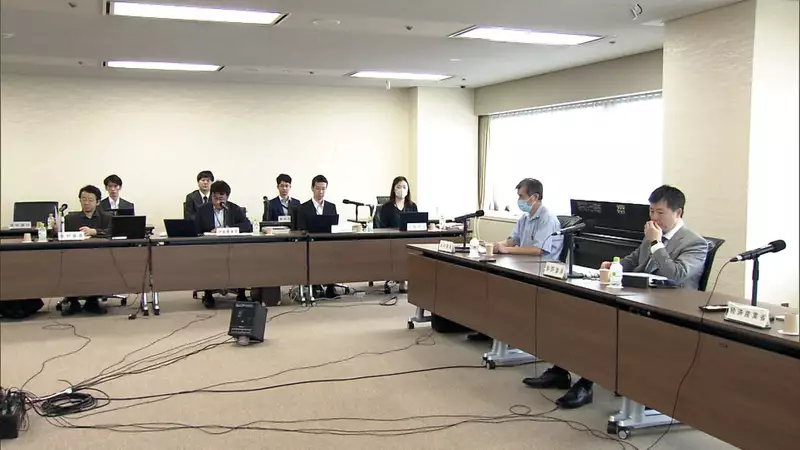
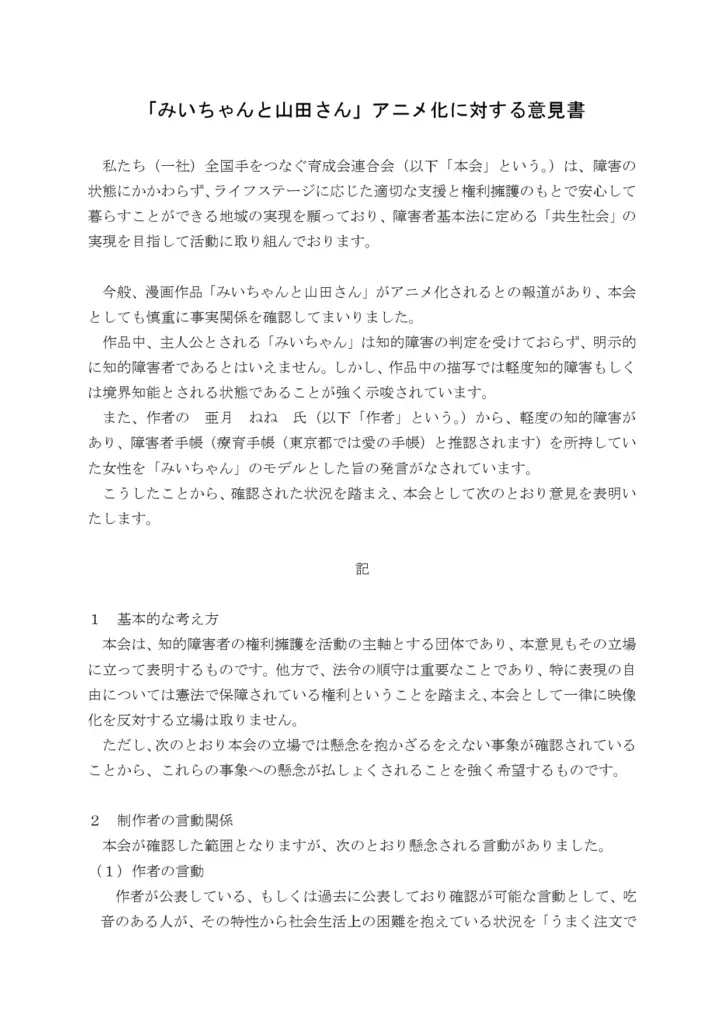
The National Association of Parents and Guardians of Persons with Intellectual Disabilities (全国手をつなぐ育成会連合会) published its written opinion on August 19, addressing the planned anime adaptation and asking the production committee to provide further explanations about how the series will handle its sensitive subject matter.
However, there is an important distinction here: the organization is not calling for the anime to be cancelled.
Instead, it says it does not oppose the adaptation outright, but has concerns about the work, its creators and publisher, and the possibility that the anime could contribute to prejudice or misunderstanding toward people with intellectual disabilities.
Organization Does Not Oppose the Anime’s Adaptation
The National Association of Parents and Guardians of Persons with Intellectual Disabilities is a nationwide organization made up of people with intellectual disabilities, their families and supporters.
It has organizations affiliated with all 47 prefectures as well as designated major cities, with around 100,000 members across the country. Its activities include promoting understanding of intellectual disabilities, protecting the rights of people with disabilities, making policy recommendations and supporting activities led by people with disabilities themselves.
In its statement, the organization emphasized that it understands freedom of expression is protected as a constitutional right.
Because of that, it explicitly stated that it does not take a blanket position against adapting the manga into an anime.
However, it said that several issues surrounding Mii-chan and Yamada-san have raised concerns that it believes need to be addressed before the anime is released.
Organization Says Mii-chan Is Not Explicitly Identified as Having an Intellectual Disability
One of the points addressed in the statement concerns the protagonist, Mii-chan.
The organization noted that Mii-chan is not explicitly diagnosed with an intellectual disability within the manga, meaning she cannot simply be described as an officially identified person with an intellectual disability based on the work itself.
However, it believes that the way the character is portrayed strongly suggests a condition that could be interpreted as mild intellectual disability or borderline intellectual functioning.
The organization also points to statements from manga creator Nene Azuki, saying that she has previously indicated that a woman believed to have had a mild intellectual disability and possessed a disability certificate served as a model for Mii-chan.
Because of this connection, the organization believes the way Mii-chan is portrayed deserves particular consideration when the story moves from manga to animation.
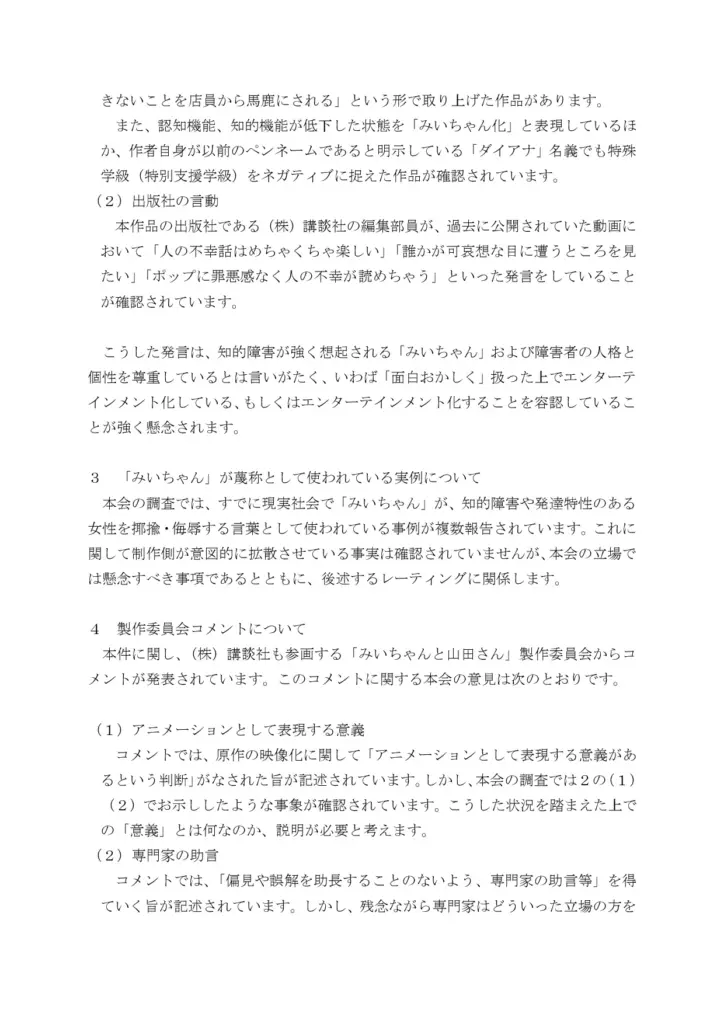
Concerns Over the Author’s Past Statements and Works
The organization also raised concerns about several past works and statements associated with the manga’s creator.
According to its statement, it found previous work depicting a person with a stutter experiencing difficulties in everyday life, including being mocked by a store employee because of their difficulty speaking.
It also pointed to the use of the expression “Mii-chan-ification” to describe a decline in cognitive or intellectual functioning.
Additionally, the organization referenced works previously published by the author under the pen name Diana, which it says portrayed special-needs education classes in a negative manner.
The organization stressed that these examples were among the reasons it became concerned about whether people with intellectual disabilities and their individual personalities are being treated with sufficient respect.
Concerns Also Extend to a Kodansha Editor
The statement did not stop with the manga’s creator.
The organization also raised concerns about comments previously made by an editor at Kodansha, the publisher of Mii-chan and Yamada-san.
It said that the editor had appeared in a previously published video where comments were made that could be interpreted as expressing enjoyment of other people’s misfortune as entertainment.
The organization specifically highlighted comments along the lines of enjoying people’s unfortunate stories and watching someone experience misfortune.
It argued that such comments, when considered alongside the portrayal of Mii-chan and the broader concerns surrounding disability, raise questions about whether people with intellectual disabilities are being treated with sufficient respect or instead being turned into entertainment.
What Does the Anime Adaptation Actually Aim to Achieve?
Perhaps one of the strongest points in the statement concerns the production committee’s explanation for why Mii-chan and Yamada-san should be adapted into an anime in the first place.
The anime’s production committee previously stated that it had determined there was significance in expressing the original work through animation.
The National Association of Parents and Guardians of Persons with Intellectual Disabilities wants the committee to explain what that significance actually is.
The organization argues that considering the concerns it has identified surrounding the creator and publisher, a clearer explanation is necessary regarding what the anime is trying to accomplish through its adaptation.
In other words, the organization isn’t simply asking, “Why are you making this anime?”
It is asking the production side to explain what the anime adaptation is supposed to achieve and why turning this particular story into animation is meaningful despite the concerns surrounding its portrayal of disability.
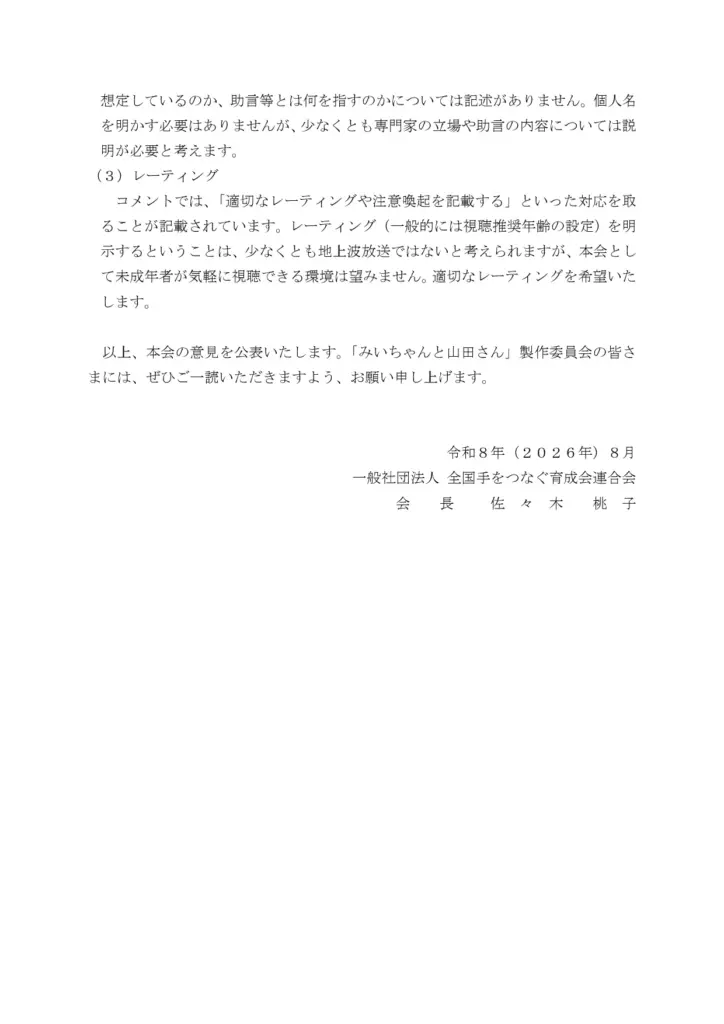
Organization Wants More Information About the “Experts” Advising the Production
Another major issue is the production committee’s promise to seek advice from experts to prevent the anime from promoting prejudice or misunderstanding.
The organization welcomed the idea of expert involvement but said the production committee has not explained what kind of experts are being consulted or what their advice will actually involve.
It does not necessarily demand that individual names be publicly revealed.
Instead, it wants the production committee to provide at least some information about the experts’ positions and the nature of the advice they are providing during production.
This is particularly notable given the earlier controversy surrounding claims that expert supervision and training would be involved in the anime’s production.
Organization Calls for Appropriate Age Rating
The organization also addressed the anime’s planned rating.
The production committee previously stated that it would include an appropriate rating and warnings for viewers.
However, the National Association of Parents and Guardians of Persons with Intellectual Disabilities said that ratings generally function as recommendations regarding the appropriate viewing age.
It added that, based on the statement from the production committee, it appears the anime may not be intended for terrestrial television broadcasting.
More importantly, the organization said it does not want minors to have an environment where they can casually watch the anime, and called for an appropriate rating to be established.
This does not mean the organization is demanding that the anime be banned.
Rather, it wants the production committee to take the subject matter seriously enough to ensure that viewers—particularly younger audiences—are given appropriate warnings and age restrictions.
“Mii-chan” Is Also Reportedly Being Used as a Derogatory Term
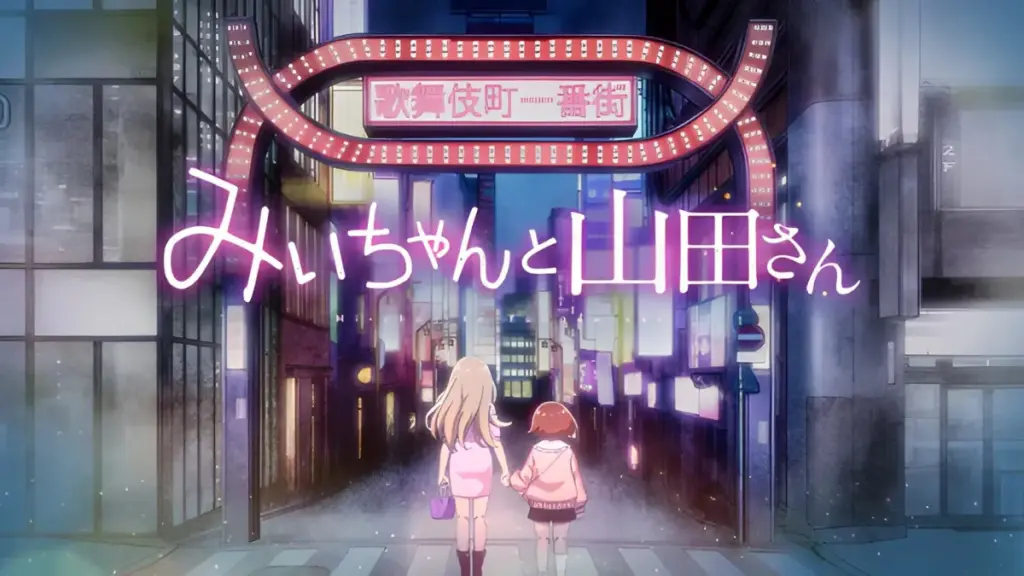
Another concern raised in the statement involves the name itself.
The organization said its investigation found multiple examples of “Mii-chan” being used in real-world situations as a mocking or insulting term toward women with intellectual disabilities or developmental characteristics.
The organization acknowledged that it did not find evidence that the anime’s production side was intentionally spreading the term in this way.
Nevertheless, it considers the existing use of the term something that needs to be taken seriously, particularly when determining the anime’s rating and how the adaptation will be presented to audiences.
This adds another layer to the debate, because the concern is no longer limited to what happens inside the fictional story. It also involves how terminology associated with the work may be used outside of it.
The Anime Controversy Continues
Mii-chan and Yamada-san has already attracted significant discussion following the announcement of its anime adaptation.
The manga follows Yamada, a cabaret club worker, and newcomer Mii-chan in 2012 Shinjuku, portraying women living through poverty, isolation, exploitation and circumstances that leave them vulnerable to falling through the cracks of society.
The work has received support for tackling difficult social issues, while also facing criticism over how its portrayal of intellectual and developmental disabilities could potentially influence perceptions of people living with those conditions.
The latest statement adds another major voice to that discussion.
But once again, the position of the National Association of Parents and Guardians of Persons with Intellectual Disabilities is not a demand to cancel the anime.
Instead, the organization is asking the production committee to address its concerns, explain the purpose of the adaptation, clarify the role of the experts advising production, and establish an appropriate rating and warnings.
With the anime currently planned for 2027, the debate surrounding Mii-chan and Yamada-san is clearly not going away anytime soon.
Souce: Kai-You