Black manga artist Minami Sakai has received attention after her latest one-shot, Enkyori Osananajimi (Long-Distance Childhood Friends), was published in Japan’s FEEL YOUNG magazine. While the artist celebrated the achievement as a long-awaited milestone, some social media users responded with racially charged and sexually explicit comments after making incorrect assumptions about the story’s main characters.
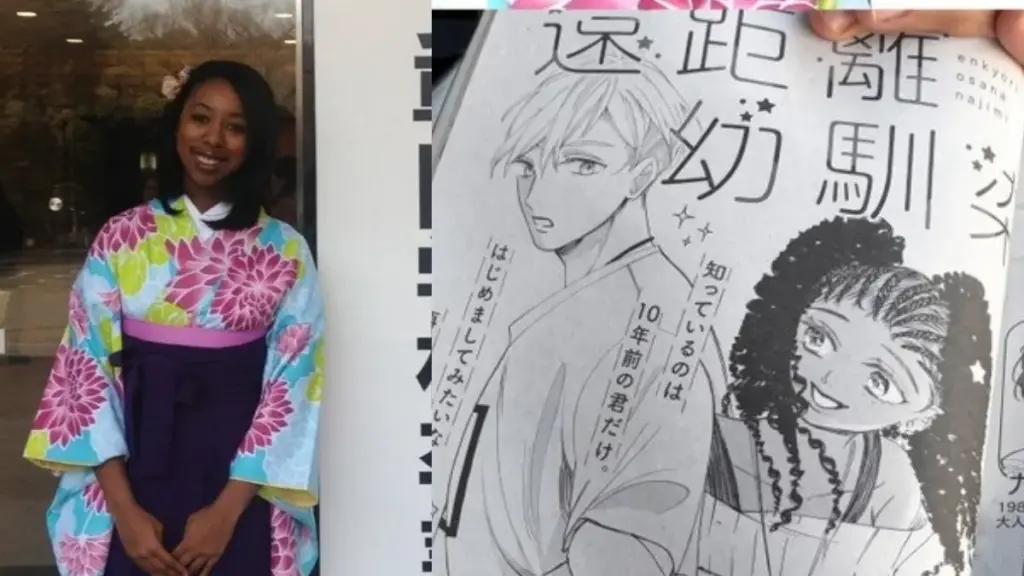
The controversy began gaining attention after Sakai shared a photograph of herself holding a physical copy of the magazine on November 8, 2026. Alongside it, she posted an older photograph of herself and reflected on how far she had come to achieve her dream.
“What would she think if she knew that her hard work actually paid off,” she wrote on X.
Her latest work, Enkyori Osananajimi (Long-Distance Childhood Friends), is a one-shot featured in the November 2026 issue of FEEL YOUNG, published by Shodensha. The issue was released on October 8.
However, what should have been a moment to celebrate her accomplishment soon attracted an entirely different kind of attention.
Some Social Media Users Mocked Her Manga Over Its Main Couple
The controversy largely revolved around the relationship between the manga’s two main characters.
Some English-language users assumed that the male character was white and began mocking Sakai for depicting a romance between a Black woman and a white man. Several comments went beyond criticism of the fictional pairing, using sexually explicit and racially charged language to ridicule the artist.
One particularly crude comment, circulated in a Japanese-language post discussing the controversy, mocked her for being a Black woman drawing a romance with a supposedly white male character. The discussion also described comments suggesting that she had a sexual preference for white men.
However, there was a significant problem with these assumptions.
The male character is not white. He is Japanese.
His name is Jun Maeda, and he is identified as a Japanese character in the story. Some users had seemingly assumed his ethnicity based on his lighter skin tone, leading to an argument built around an incorrect reading of the manga.
A Black woman drawing a romance with a white man? ‘Biwisi,’ lol.
The incident drew criticism of its own, with people questioning why a manga artist’s race should determine which characters she is allowed to create or which relationships she can portray.
Some users reportedly questioned why a Black manga artist would write a romance involving a Black female character and a supposedly white male character. Others accused Sakai of having a fetish for being “taken by a white man.”
Minami Sakai Has Already Been Working Professionally as a Manga Artist for Four Years
Amid the attention surrounding her latest publication, Sakai also clarified an important detail about her career.
Although many people were congratulating her as though she had just entered the manga industry, she explained that she had already been working professionally for four years.
In a post on X, she revealed that her first series had ended around two years earlier and that she had only recently managed to get her next series approved after a year of struggling.
Her latest appearance in FEEL YOUNG is therefore another important step in an established professional career, rather than her first experience as a manga artist.
She also shared another clarification after people began interpreting her older photograph in different ways.
“Can’t believe I have to say this, but this is ME and I am VERY MUCH ALIVE and still making manga!” she wrote, explaining that she was simply looking back at an old photograph and congratulating her younger self.
Despite the attention, she indicated that she was getting back to work rather than allowing online negativity to distract her.
Japanese Readers Also Shared Messages of Support
While some users focused on criticising the fictional relationship, other readers responded positively to Sakai’s achievement.
Several Japanese-language replies congratulated her, praised her artwork and encouraged her to continue creating manga.
One Japanese X user shared a particularly supportive message:
“The talent to create something from nothing is the most precious talent in this world. I’m rooting for you, friend from another country.”
Other readers also expressed interest in finding and reading Enkyori Osananajimi, while praising the effort involved in building a career in Japan’s competitive manga industry.
The contrast between the supportive messages and the racially charged remarks has become part of the wider discussion surrounding Sakai’s publication.
However, the full scale of the negative reaction remains unclear, and the available posts do not establish how many people participated in the harassment.
A Manga Artist Should Be Free to Tell the Stories She Wants
Sakai’s latest publication is ultimately a milestone worth celebrating.
Getting a one-shot published in an established Japanese manga magazine requires creative work, persistence and the ability to navigate a competitive publishing industry. Her own comments about the struggles of getting another project approved make that achievement all the more meaningful.
Yet some of the online reaction focused less on her artwork and more on what certain users believed a Black manga artist should or should not create.
There is nothing unusual about manga featuring characters from different backgrounds or relationships between people of different ethnicities. Nor should an artist’s identity become a reason to police the fictional relationships they choose to write.
Readers are free to dislike a story, criticise its characters or express their opinions about its writing. But turning an artist’s racial identity into an excuse for sexualised insults is an entirely different matter.
For now, Sakai has made it clear that she is still creating manga and moving forward with her work. Her latest one-shot is already published, regardless of what strangers on social media think she should be drawing. Bookmark Otaku Mantra for more amazing updates.