Japanese teenagers may be growing up in a digital-first world, but that doesn’t mean they are abandoning physical manga. A new survey in Japan has revealed that 44% of manga readers in their teens primarily prefer physical manga, compared with just 29% of readers in their twenties. The findings challenge the assumption that younger generations are moving entirely towards digital reading.
The results come from the Manga Awareness Survey 2026, released by manga-related business company Comici on November 3, Japan’s Manga Day. The survey questioned 3,000 people aged 15 to 69 about their manga-reading habits, preferred formats, methods of discovering new series, and attitudes towards AI involvement in manga production.
Beyond the unexpected preference for printed manga among teenagers, the survey also revealed that younger readers are more likely to discover new series through social media and express resistance towards manga created with AI involvement.
Japanese Teenagers Still Prefer Physical Manga Over Digital
One of the most surprising findings concerns the relationship between younger readers and printed manga.
According to the survey, 44% of teenage manga readers identified physical books as their primary reading format, compared with 29% of readers in their twenties.
The difference challenges the common assumption that people who grow up with smartphones and digital entertainment naturally prefer reading everything online.
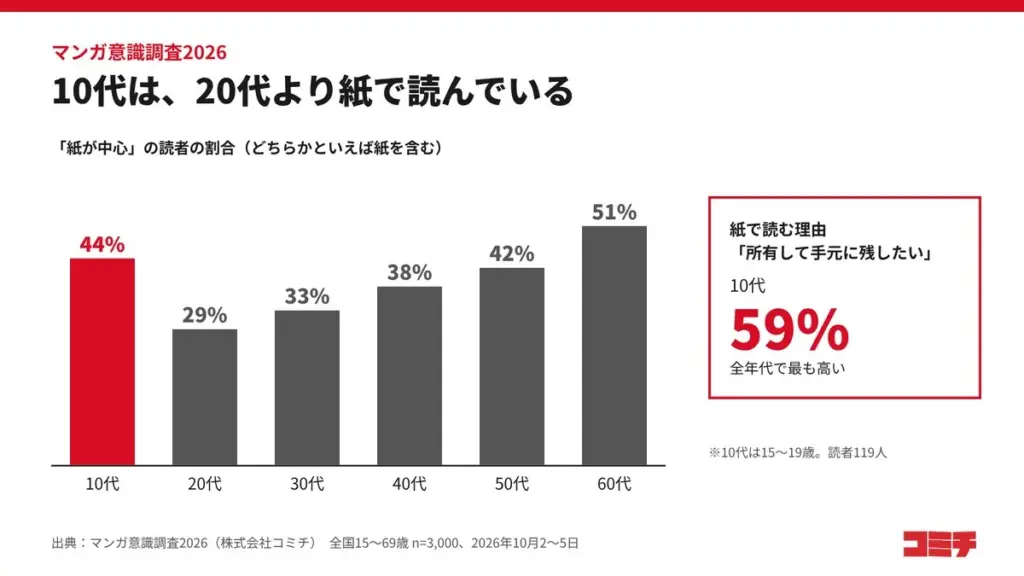
The survey also explored why readers continue to choose physical manga. Among teenage readers who preferred printed editions, 59% said they wanted to own the manga and keep it for themselves, the highest proportion among all age groups.
For these readers, purchasing a physical volume offers something beyond simply accessing a story. Having a favourite series on a bookshelf and being able to revisit a physical collection remain important parts of the manga-reading experience.
However, this doesn’t mean teenagers have rejected digital manga. The findings suggest that younger readers continue to appreciate physical ownership despite having access to convenient digital platforms.
The survey also noted that the teenage reader group included 119 respondents for this particular finding, so the result should be considered within that sample size.
Manga Readers Are Combining Physical Books and Digital Platforms
The survey also examined how Japanese readers consume manga across different formats.
Among respondents, 34.4% had read physical manga volumes during the past year, while 34.1% had used manga apps or websites. Meanwhile, 17.6% had read printed manga magazines.
Looking specifically at manga readers, the survey found that most were not exclusively dependent on one format.
| Reading Preference | Manga Readers |
|---|---|
| Both physical and digital | 48.1% |
| Digital only | 30.0% |
| Physical only | 22.0% |
Readers who used both formats accounted for the largest group at 48.1%.
This suggests that physical and digital manga are not necessarily competing with each other for every reader. Someone might read an ongoing series through a smartphone app while purchasing physical volumes of their favourite titles.
Printed books also offer a different experience for collectors and readers who want to keep their favourite works.
Rather than a complete transition from paper to digital, the results indicate that Japanese manga readers are increasingly using both formats.
Are Young People Really Abandoning Manga?
The survey also examined the idea that younger generations are losing interest in manga.
Across all 3,000 respondents, 51.5% said they had read manga during the previous year, while 48.5% had not.
At first glance, the fact that almost half the respondents hadn’t read manga recently might suggest that the medium is losing readers. However, the breakdown of non-readers offers a more complicated picture.
According to the survey:
- 32.8% had not read manga five years ago and still did not read it.
- 6.7% had reduced their manga consumption compared with five years earlier and no longer read manga.
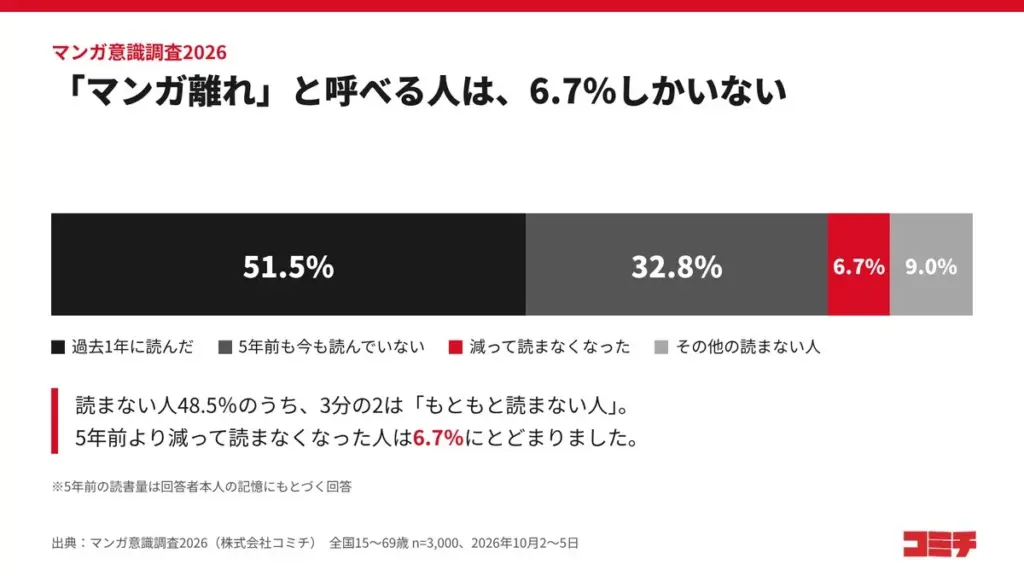
This means a considerable portion of people who currently don’t read manga were already non-readers rather than former readers who abandoned the medium.
Of course, the findings do not prove that manga readership is completely unaffected by changing entertainment habits. They do, however, suggest that the idea of widespread manga abandonment needs a closer look.
The way people discover and consume manga may be changing, rather than the medium simply losing its audience.
Japanese Teenagers Discover Manga Through Social Media
Another interesting finding concerns how readers discover new manga.
Across all age groups, the most common discovery channels were:
| Manga Discovery Method | Respondents |
|---|---|
| App and digital bookstore rankings | 28% |
| Physical bookstore displays | 26% |
| Social media posts and discussions | 22% |
However, social media plays a considerably larger role among younger readers.
37% of teenage respondents identified social media posts and discussions as a way of discovering new manga, compared with only 10% among people aged 50 and above.
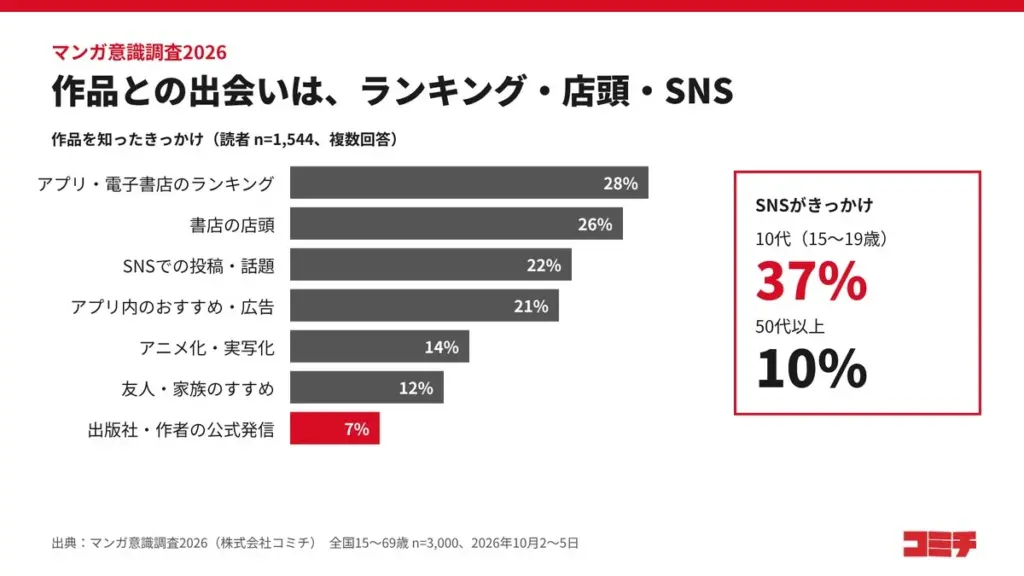
This highlights how platforms such as X and other social networks have become important spaces for manga discovery.
Readers can encounter a new series through a viral manga panel, an author’s illustration, fan recommendations, or discussions surrounding an ongoing story.
For publishers and manga creators, this also means that social media visibility can help introduce works to audiences who might not otherwise encounter them through traditional bookstores or magazine advertisements.
Japanese Teenagers Show Greater Resistance to AI-Involved Manga
Perhaps one of the most unexpected findings concerns artificial intelligence and its role in manga production.
The survey asked respondents about their attitudes towards manga that involved AI in the creative process. The results revealed a noticeable difference between age groups.
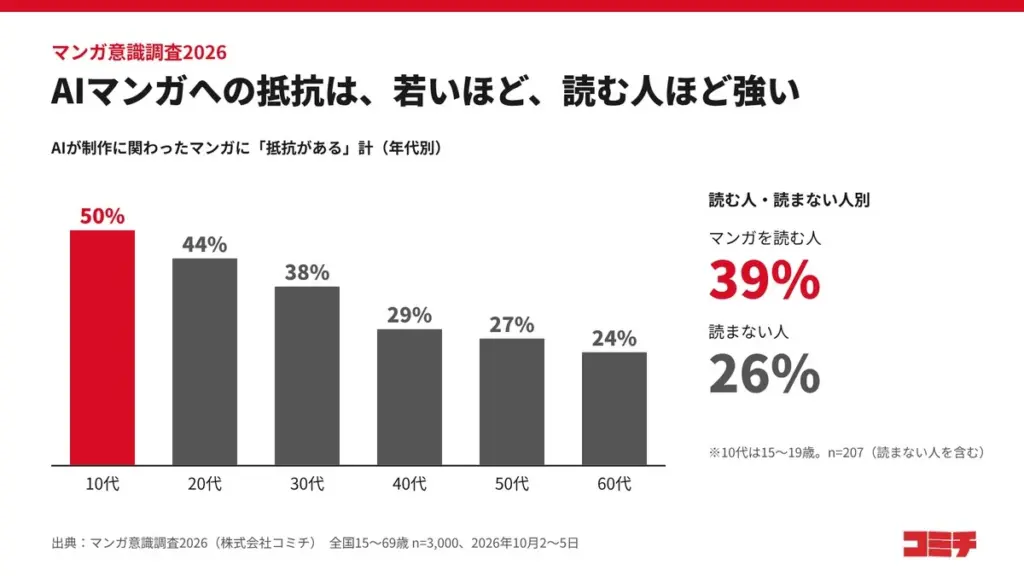
50% of teenage respondents expressed resistance to AI-involved manga, compared with 24% of respondents in their sixties.
The survey also found differences based on reading habits:
- Manga readers: 39% expressed resistance.
- People who did not read manga: 26% expressed resistance.
This suggests that people who actively read manga may be more cautious about the involvement of AI in its production.
However, the survey does not establish exactly why respondents feel this way. It does not identify whether their concerns involve artistic originality, the role of human creators, copyright, or the quality of AI-assisted work.
Nevertheless, the findings challenge another common assumption about younger audiences. Growing up surrounded by digital technology does not necessarily mean being more accepting of AI-generated creative content.
What the Manga Awareness Survey 2026 Reveals About Japanese Readers
Taken together, the findings paint a more complicated picture of manga consumption in Japan.
Teenagers are showing a strong preference for physical manga compared with readers in their twenties, while also relying more heavily on social media to discover new titles. At the same time, they are among the most resistant age groups when it comes to AI involvement in manga production.
Meanwhile, readers across different generations are combining physical and digital formats rather than abandoning printed books entirely.
The results suggest that the relationship between manga and its audience is changing in several ways. Ownership, online discovery, reading habits, and attitudes towards creative technology all influence how people interact with the medium.
For the manga industry, understanding these differences could be important when developing publishing strategies, promoting new series, and deciding how technology should be incorporated into creative production.
Perhaps the real question isn’t whether young people are abandoning manga, but how their expectations of manga are changing.
Bookmark Otaku Mantra for more anime and manga industry news and updates!
About the Manga Awareness Survey 2026
The Manga Awareness Survey 2026 was released by Comici, a company involved in manga-related business, to coincide with Manga Day in Japan on November 3.
The survey was conducted online by MyVoice Communications between October 2 and October 5, 2026, using the MyVoice panel.
It collected 3,000 valid responses from men and women aged 15 to 69 across Japan, including 1,544 respondents who had read manga during the previous year.
The research examined manga consumption habits, preferred reading formats, methods of discovering new works, and attitudes towards AI involvement in manga production.
Source: Oricon