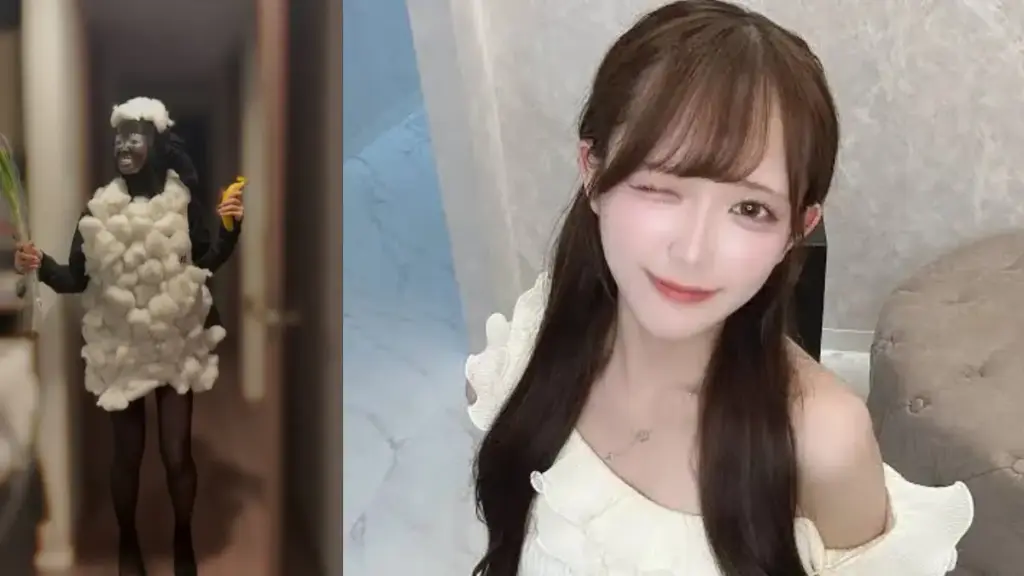
Japanese voice actress and performer Hazuki Tanda has become the subject of an international social media controversy after sharing photographs of her Halloween costume inspired by Shaun the Sheep. The photos, posted on October 31, show Tanda recreating the popular sheep character with a black-painted face, a white woolly costume, and vegetables and a banana as props.
While the costume was intended to recreate the appearance of the animated character, some international users accused Tanda of wearing blackface, arguing that the combination of dark face paint, cotton-like material and a banana evoked racist imagery associated with Black people.
The criticism quickly spread across X, where users debated whether the costume was an innocent recreation of a fictional character or an insensitive use of imagery with a long history of racial discrimination.
However, plenty of users also came to Tanda’s defence, arguing that the character she was recreating is quite clearly a sheep and that the controversy was overlooking the context of the original costume.
Hazuki Tanda’s Shaun the Sheep Halloween Costume Sparks Controversy
On October 31, Tanda shared photographs of her Halloween costume on her official X account with the simple caption:
“Happy Halloween 🐑🎃”
The costume recreates Shaun, the titular character from British stop-motion animated series Shaun the Sheep. The character has a dark face and legs, with white wool covering most of his body.
Tanda recreated these features using dark face paint and a costume made to resemble Shaun’s distinctive woolly appearance. She also posed holding a banana and vegetables.
Tanda’s original post did not include any explanation or commentary about race. It was presented as a Halloween costume.
However, photographs of the costume began circulating internationally, with some users focusing on the black face paint and the combination of props and white cotton-like material.
The discussion soon moved beyond whether the costume was appropriate and became a wider argument about blackface, racial stereotypes, and differences in cultural interpretation.
International Users Accuse Hazuki Tanda of Blackface
Some of the reactions directed at Tanda were particularly accusatory.
One X user criticised the costume and argued that people should understand why painting one’s face black could be considered racist, even without knowing the complete history of blackface.
The user wrote:
“I think that even without knowing the full cultural context of blackface you should be able to realize why painting your face black might be racist 😭”
The post continued by questioning why people acted as though Japanese people were unaware of these issues.
Another user made a much broader accusation, writing in Portuguese:
“racismo no japao eh a norma ent ela pode fazer isso”
Translated into English, the statement reads:
“Racism in Japan is the norm, so she can do this.”
The comment sparked further disagreement because it went beyond criticising the costume and made a sweeping statement about racism in Japan.
Criticism also came from Japanese-language accounts. One user, @Kisnarou, argued that Tanda might not understand the historical association between dark face paint and blackface.
The user wrote that even if the intention was to recreate Shaun the Sheep, the combination of painted skin and a banana was problematic. They also suggested that her agency should have stopped her from posting the photographs.
Other users questioned the decision more directly, with one simply responding:
“Why is she doing blackface?”
The criticism was not limited to the face paint itself. Some users argued that the combination of a dark face, white cotton-like material and banana could evoke historical racial caricatures, particularly imagery associated with slavery and Black people working in cotton fields.
One account described the combination as resembling an extremely offensive racial image that had come together unintentionally.
An AI-Generated Textbook Lesson About the Controversy Also Circulates
The discussion even inspired one X account to create a fictional English textbook lesson using Tanda’s Halloween costume as its subject.
The account posed questions to American, Japanese and South Korean readers about the history of blackface, the Shaun the Sheep costume, and experiences of having racism dismissed as “just a joke.”
The accompanying images presented a mock English textbook lesson titled Hazuki Tanda’s Halloween: It’s a Sheep Costume!, followed by another page discussing anti-Asian racism.
The fictional dialogue presented two competing perspectives:
- “But she’s dressed as a sheep!”
- “Then what about Asians?”
The images were labelled as AI-generated, so they should not be mistaken for an actual Japanese school textbook or official educational material.
Nevertheless, the post introduced another dimension to the discussion: while some users were questioning the costume through the history of anti-Black racism, others were raising concerns about how Asian people are treated when they speak about racism themselves.
Japanese and International Users Defend Tanda
Not everyone agreed with the criticism. Several users argued that the photographs clearly showed a recreation of Shaun the Sheep and that the costume should be understood in that context.
One particularly blunt response questioned why people were associating the costume with Black people in the first place.
Another user challenged the interpretation of the cotton and banana imagery, arguing that seeing those objects alongside something black and immediately connecting them to racial stereotypes was itself problematic.
A Spanish-language response also defended Tanda, saying:
“I only see that the costume and the post were a success. I wish I could reach that level of fame.”
The user added that cotton and fruit appearing alongside something black did not automatically make the image racist, criticising those who interpreted it that way.
Another widely shared defence focused on cultural expectations, questioning why people in different countries should constantly be expected to observe every cultural taboo established elsewhere.
Some Japanese users also pointed out that Shaun is a fictional sheep whose appearance was the obvious inspiration for the costume.
Importantly, the reactions were not divided neatly between Japanese people defending Tanda and international users criticising her. There were Japanese-language criticisms as well as international users who defended the costume.
Why Is Blackface Considered Racist?
The controversy also brings attention to the historical reasons why blackface carries such strong associations, particularly in the United States.
During the 19th century, white performers in American minstrel shows darkened their faces with makeup to portray Black people through exaggerated and deeply offensive racial caricatures.
These performances frequently depicted African Americans as ignorant, lazy, irresponsible, and inferior. The stereotypes became widespread through theatre, music, and other forms of entertainment, reinforcing racist attitudes and helping legitimise discrimination.
The National Museum of African American History and Culture explains that the first minstrel shows appeared in New York during the 1830s, featuring white performers wearing blackened faces and imitating enslaved Africans.
The legacy of these performances is one reason why blackface remains an extremely sensitive subject in many Western countries, even when someone claims that no discriminatory intention was involved.
However, the argument in Tanda’s case centres on the distinction between recreating a fictional character and portraying or caricaturing a real racial group.
Shaun the Sheep is not a human character. He is an animated sheep created by British animation studio Aardman, with a naturally dark face and white wool. The character first appeared in Wallace & Gromit: A Close Shave in 1995.
Tanda’s costume follows that character design, rather than depicting a human Black person.
This is precisely where the disagreement emerges. Critics argue that the use of black face paint can carry historical associations regardless of the intended character, while defenders believe the fictional character and the purpose of the costume should be taken into account.
Hazuki Tanda Has Yet to Issue a Separate Statement
As of November 1, Tanda’s original Halloween post is the statement available from her regarding the costume. She has not provided a separate public explanation addressing the blackface accusations in the material reviewed.
Tanda is a Japanese voice actress, actress and performer known for her work in the D4DJ franchise, where she voices Miyu Sakurada, a member of Lyrical Lily.
The controversy has also generated discussion about how international audiences interpret Japanese entertainment and cultural references, particularly when images circulate without their original context.
Whether viewers consider the costume inappropriate or simply a recreation of a beloved animated character, the debate highlights how easily online discussions can expand beyond their original subject.
For now, the controversy remains centred on Tanda’s Halloween photographs and the contrasting interpretations of her costume. There has been no confirmed announcement of disciplinary action or cancellation of her professional activities. Bookmark Otaku Mantra for more anime news and updates!
About Hazuki Tanda
Hazuki Tanda is a Japanese voice actress, actress and singer affiliated with Platinum Production. Born on February 28, 2001, in Hiroshima Prefecture, she has worked across music, acting and voice performance.
She is particularly known for voicing Miyu Sakurada in the multimedia franchise D4DJ, where she is part of the fictional DJ unit Lyrical Lily. She has also appeared in anime projects including BanG Dream! It’s MyGO!!!!!.