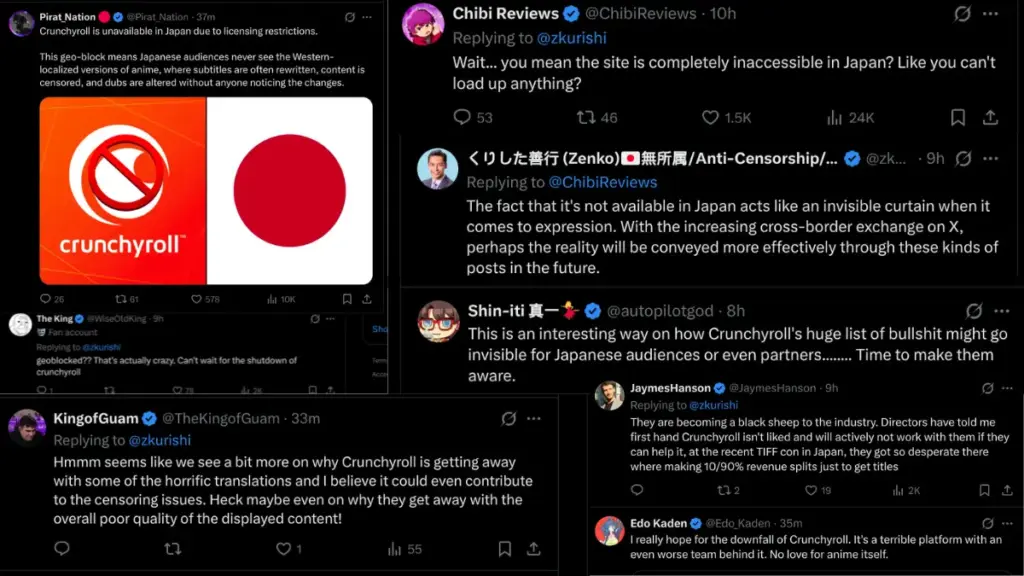
Crunchyroll is once again at the centre of controversy, but this time not directly because of the alleged data breach. Crunchyroll is banned in Japan or more precisely, it is geoblocked, meaning Japanese users cannot access it. While this has been the case for years, a large wave of international anime fans only recently discovered this fact, and social media erupted in response..
The discussion picked up rapidly on X, where multiple users pointed out that the platform is effectively geoblocked in Japan due to licensing restrictions. While this has technically been the case for years, it appears that a large portion of the global anime audience was unaware of it until now.
What shocked many fans is the irony of the situation. A platform widely seen as the “face of anime streaming worldwide” is inaccessible in the country where anime is actually produced. This realisation quickly turned into a broader discussion about how anime distribution really works behind the scenes.
Why Is Crunchyroll Blocked in Japan?
Crunchyroll is not available in Japan due to regional licensing restrictions, not a government ban. Here’s how it works:
When an anime studio produces a series, it sells streaming rights separately for each region. In Japan, domestic platforms like d Anime Store, Niconico, and Amazon Prime Video Japan hold the streaming licenses. Crunchyroll purchases the rights to stream those same titles outside Japan.
This means Crunchyroll is legally blocked from operating in Japan, not because of any controversy, but because it simply doesn’t own the rights to stream content there.
Is Crunchyroll Banned or Just Geoblocked?
To be precise: Crunchyroll is geoblocked in Japan, not government-banned. There is no law or official order prohibiting Crunchyroll. It is a business and licensing decision. When you try to access Crunchyroll from a Japanese IP address, you are redirected or shown an error because the platform restricts access based on your location.
However, many people use the terms “banned” and “blocked” interchangeably when describing this situation, which is why the topic trended so widely.
The situation gained even more attention as it surfaced alongside the ongoing reports of Crunchyroll’s alleged data breach. With claims of millions of user records being exposed and even partially sold, users have already been questioning the platform’s internal systems. This new discovery only added fuel to the fire, shifting the conversation from cybersecurity to how Crunchyroll operates globally.
Some users have raised concerns about how anime is localized for international audiences, pointing out differences in subtitles, dialogue changes, and censorship. Since Japanese viewers do not typically see these versions, critics argue that there is little direct feedback loop between original creators and the global audience experience.
At the same time, others have pushed back on the outrage, stating that this is simply how the anime industry has always functioned. Licensing is handled regionally, and platforms like Crunchyroll exist specifically to distribute anime outside Japan, not within it. From that perspective, the “geoblock” is not a sudden move, but a long-standing business structure.
Still, the timing of this discussion is what makes it significant. What was once an industry detail has now turned into a viral talking point, especially as Crunchyroll is already dealing with scrutiny from the alleged breach and data leak situation.
Amid the ongoing discussion, some users also pointed out the gap between expectations and reality when it comes to anime distribution. One viral post highlighted how many international fans want Japanese studios to handle global releases themselves instead of relying on platforms like Crunchyroll, but argued that it’s not that simple. Factors like language barriers, localisation challenges, and the lack of globally scaled streaming infrastructure in Japan make it difficult for domestic companies to operate at the same level internationally.
As of now, Crunchyroll has not issued any official statement regarding the renewed backlash over its availability in Japan. However, the conversation continues to grow, with more fans questioning how much they really understand about the platform they use daily.