Cosmic Princess Kaguya! (Japanese Title: Chou Kaguya-hime!) made its debut on Netflix on January 22, 2026 and saw the start of a one-week limited theatrical release in Japan on February 20. The movie is a near-future, yuri reimagining of The Tale of the Bamboo Cutter that has Shingo Yamashita (Pokétoon chief director, opening storyboard artist and director for Chainsaw Man, Jujutsu Kaisen Season 1 and more) in his feature film directorial debut and music contributions from vocaloid producers ryo (supercell), 40mP, HoneyWorks, yuigot, Aqu3ra and kz(livetune).
The Princess Kaguya-inspired premise sees teenage student Iroha Sakayori meeting Kaguya, who first emerges from a telephone pole as a baby. The duo later get involved with the virtual realm of Tsukuyomi, which Yachiyo administrates, and form a music/streaming partnership.
What do you get when you combine The Tale of the Bamboo Cutter with the online culture inspirations of BELLE and a pinch of the sapphic affection in Revolutionary Girl Utena? You get a chromatic maelstrom such as the fantasy sci-fi musical Cosmic Princess Kaguya!. This is a Gen Z-inspired blowout but a great romp through a relationship that defies time and space, the laws of nature, and the inevitability of growing up.
Netflix seems to be very poorly promoting this musical anime to the general public awareness for its U.S. viewers, much as if the 2025 The Rose of Versailles MAPPA musical film was intended to be part of a niche audience viewing experience for Western viewers. The mind behind Cosmic Princess Kaguya! is director Shingo Yamashita, who also directed the openings for Chainsaw Man and the first season of Jujutsu Kaisen and co-writer Saeri Natsuo. Yamashita’s Studio Chromato worked on this with Studio Colorido, who also brought off other good coming-of-age fantasies such as Penguin Highway and A Whisker Away.
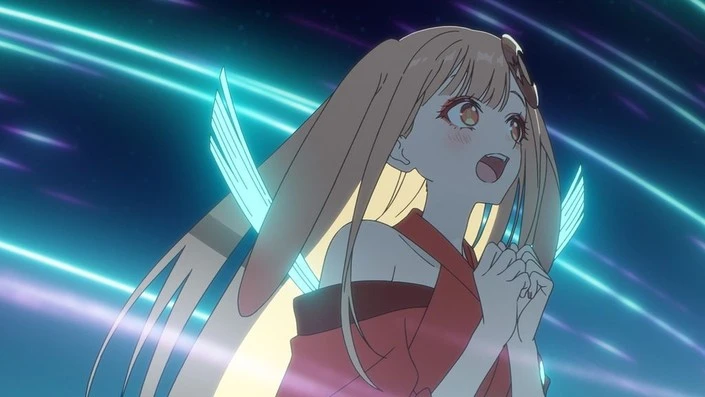
17-year-old Iroha is busy juggling jobs and maintaining her status as a model student. However, still in mourning for her father’s passing, she is estranged from her mother and struggling to pay her rent. Destiny, in the most unorthodox manner possible, responds to her desire for something different by having a comet lightning strike a light pole and handing Iroha a sleeping baby. A bewildered Iroha coerces herself into taking home this strange, magical child. Soon, the child grows into a girl who can talk.
Iroha figures out that this alien-like girl’s appearance and convenient development is not unlike the heroine in a famous Japanese folktale The Tale of the Bamboo Cutter. If you’re familiar with the underrated gem The Tale of Princess Kaguya by Isao Takahata, you’ll understand the basics of Kaguya’s moon origin, her arrival on earth via a bamboo stack to her earthly father and adoptive father, her transformation into an object of desire for potential husbands, and finally being forced into a sordid life where she’s returned to the moon court and purged of any earthly memories. Doing the math, this “Kaguya”, as the film dubs her, could very well be returned to the moon people at some point in the future.
However, mischievous Kaguya refuses to accept this dark predetermined outcome that looms over this film. “I’m going to make my own happy ending,” she exclaims, a rallying cry that resonates with Iroha’s sense of the trappings of adulthood. This caffeinated ball of energy is a giggling Kaguya who devours earthly pleasures at the cost of Iroha’s purse strings, although she brings much-needed sparkle to her serious life.
The two have their hideaway in the omnipresent Tsukuyomi, a VR cyberspace ruled by the popular AI Idol Yachiyo, a Hatsune Miku-inspired character. The awe-striking cosmopolitan shines as a neon-futurism with feudal architecture. Tsukuyomi is the setting for musical concerts and extraordinary competitions.
It is also in the VR World that most of the songs – attributed to human bands, not an Idol AI, with Vocaloid producers ryo (supercell), 40mP, HoneyWorks, yuigot, Aqu3ra and kz(livetune) – emerge into the forefront of their bonding moments. The English dub even hired lyricists Adam James, Brandon McInnis, Karine Costa and Ama Lee, who take the English translation with diligence for the setting.
It should be remembered that the VR World Wide Web and its AI Idol function more as background props in a twisty plot and less as conduits for commentary: anons proposing marriage in Kaguya’s comment sections, which spark an ingénue Kaguya to begin a duel for her marriage, is a substitute for the original story’s chapter on Kaguya’s suitors, or atleast a passing familiarity with internet misogyny. The story develops Yachiyo less as a cobble of algorithmic-assemblages and more as a soul. To dissect this AI Idol further would be to spoil a twist.
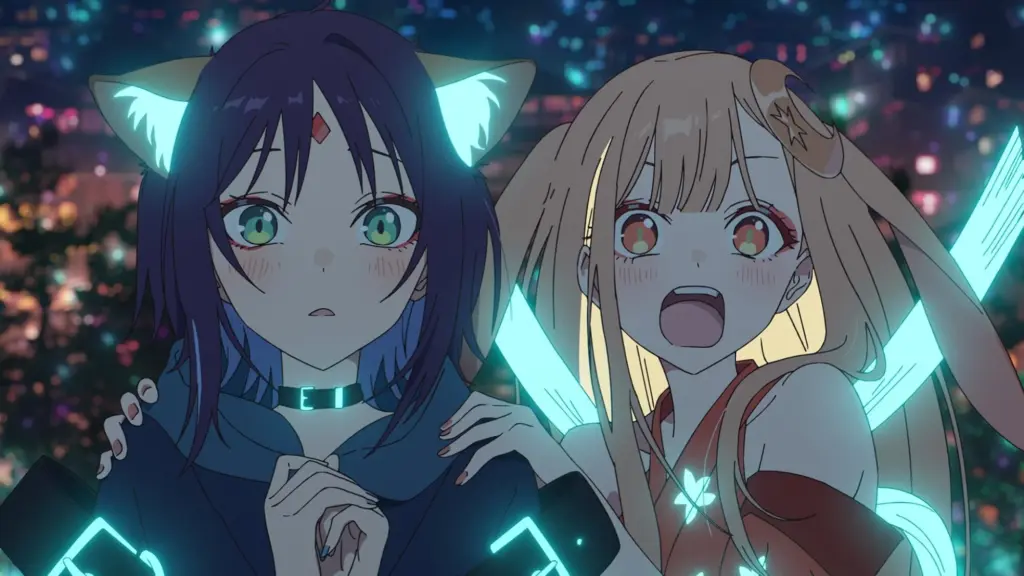
Talking about the twist, the script unfortunately marries the pacing with some awkward and unrefined decisions. Some of the issues include the Black Onyx rival streamer trio, the ringmaster, the shirtless Mikado and the source of the soap opera twist that clunks in the middle. Issues aside, the animated sight gags go off with a bang to the eye. The art style adopts a softened approach, paired with iridescence lights and neon jazz. If you notice the vista underrenderings, they are deliberately planted in the virtual world. The film also has a “psych” fake ending that proves this film was crafted for a streamer platform, but it could easily make a theater audience laugh. Gold stars are deserved for Conisch’s eclectic score of jazzy modernism and antiquated twangs.
While it is entertaining to see how the third act weaves the fantasy and sci-fi elements together with a cool swagger, the process has a touch of head-scratching. Not all the rocking notes reach the moon, but one cannot help but enjoy the riffs. Bookmark Otaku Mantra for more content!
Final Score: 8/10