Japan’s anime industry continues to attract aspiring creators, but enthusiasm for the work doesn’t necessarily mean students feel confident about building a career in it. A new survey by Japanese recruitment company Wakuwork found that 94.7% of students hoping to enter the anime industry have a positive view of the work’s sense of fulfilment, while more than 60% hold negative opinions about salary levels.
The survey also found that 58.2% of respondents have a negative impression of working conditions. Despite these concerns, 70.5% view the industry’s future positively, suggesting that students remain interested in anime careers even as they question whether the industry can offer the working environment and financial stability they expect.
Wakuwork published its 2026 Anime Industry Employment Awareness Survey Report on November 25. The company collected 302 valid responses through an online questionnaire between September 11 and September 30, 2026. Participants included middle school and high school students, university and graduate students, vocational school students, and people living overseas who hope to work in the anime industry.
Vocational school students accounted for the largest share of respondents at 43.7%, followed by third- and fourth-year university students, who together represented 37.7%.
Students Are Passionate About Working in the Anime Industry
The survey first examined how interested respondents were in pursuing a career in anime.
When asked to rate their interest on a five-point scale, 79.1% gave the highest possible rating of 5, while another 18.2% chose 4. This means that more than 97% of respondents expressed a strong interest in working in the industry.
The most popular career choice was animation drawing, in-between animation, and finishing, selected by 62.3% of respondents.
Other popular choices included:
- Director and episode direction: 35.1%
- Character design and art: 32.1%
- Production assistant: 27.8%
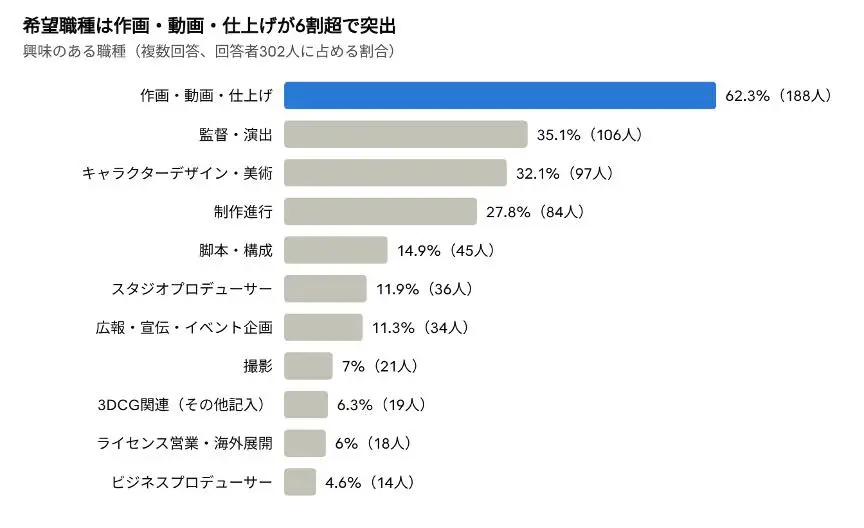
The results show that many aspiring professionals want to work directly in the creative and production processes behind anime, although the survey also attracted students interested in production management and other roles.
When asked why they wanted to enter the industry, 78.8% said they wanted to participate directly in creating works they loved. Another 77.5% wanted to pursue creative work.
For these students, working in anime is clearly about more than simply finding employment. They want to contribute to the stories and visual experiences that inspired them in the first place.
94.7% See Anime Work as Rewarding, But Salary and Working Conditions Receive Poor Ratings
The most revealing part of the survey appears when students’ enthusiasm for anime careers is compared with their expectations about the actual working environment.
Wakuwork asked respondents to evaluate several aspects of the anime industry. The results showed a considerable difference between their perceptions of creative fulfilment and employment conditions.
How Students View the Anime Industry:
| Category | Student responses |
|---|---|
| Positive view of work fulfilment | 94.7% |
| Positive view of industry prospects | 70.5% |
| Negative view of salary levels | 61.9% |
| Negative view of working conditions | 58.2% |
The difference is particularly striking when looking at compensation. Although students overwhelmingly believe anime work can be rewarding, 61.9% have a negative impression of salary levels. Another 58.2% expressed negative views about working conditions.
The most positive ratings for both salary and working conditions barely reached around 1% of respondents.
Interestingly, third- and fourth-year university students viewed working conditions more critically than vocational school students.
The results suggest that students can feel strongly attracted to the creative side of anime production while remaining cautious about the employment conditions they might encounter after graduation.
Working Conditions Rank Above Salary When Students Choose an Anime Company
The concerns surrounding employment conditions also appear in the factors students consider when choosing where to work.
Wakuwork asked participants to rank eight different considerations and found that 83.4% placed having a good working environment among their top three priorities.
A well-established training and education system ranked second at 78.5%, followed by higher salary levels at 69.2%.
Other considerations included:
| Job selection factor | Students placing it in their top three |
|---|---|
| Good working environment | 83.4% |
| Established training system | 78.5% |
| Higher salary | 69.2% |
| Regular full-time employment | 68.5% |
| Company brand and track record | 60.9% |
| Ability to commute from current residence | 38.1% |
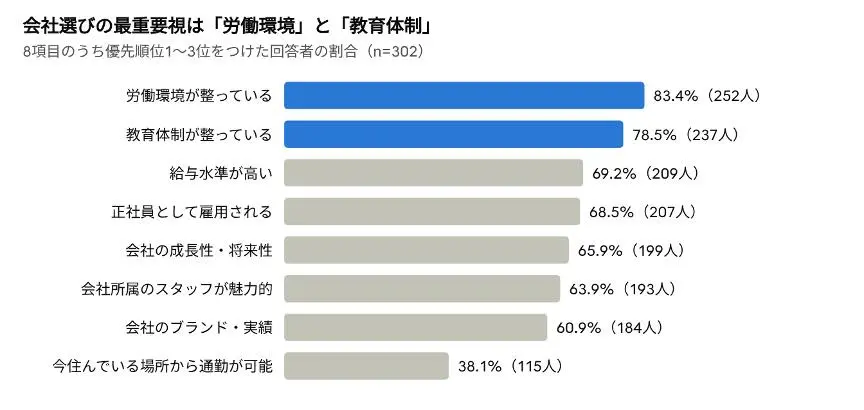
The emphasis on training is particularly interesting because many respondents are still studying and preparing to enter a specialised industry.
Students aren’t only looking for companies that offer employment. They also want workplaces where they can develop the technical skills needed to build a career.
The survey also asked participants to identify their biggest concerns about finding a job in anime.
Long working hours and holidays ranked first at 24.5%, followed closely by salary and employee benefits at 24.2%. A lack of specialised technical skills came third at 22.8%.
There were also differences between educational groups. Vocational school students were relatively more concerned about insufficient skills, with 27.3% selecting that option. Among third- and fourth-year university students, 21.1% highlighted a lack of information about recruitment routes and professional connections.
Nearly 70% Expect to Relocate to Find Work in Anime
Another interesting finding concerns where aspiring anime professionals expect to work.
The survey found that 70.2% of respondents anticipate moving to another location when they enter the industry.
The situation appears particularly challenging for students living outside Japan’s major metropolitan areas. Among respondents living outside the Tokyo metropolitan area, 76.3% said they would need to relocate because they could not find an anime industry employer within commuting distance of their current residence.
This highlights another challenge for students hoping to enter the industry. Even when someone has the necessary skills and motivation, finding an appropriate employer could mean moving away from home.
Relocation can also bring additional expenses, including rent, transportation, and other living costs. For students already concerned about salary levels, these considerations could become an important part of deciding whether they can afford to pursue an anime career.
Students Rely More on Company Websites and Social Media for Job Information
Wakuwork also examined where aspiring professionals look for information during their job searches.
Company websites ranked first, with 67.2% saying they use them frequently or plan to use them regularly. Company social media accounts followed at 62.6%, while general employment information websites received 32.8%.
This suggests that direct communication from anime studios and companies plays an important role in reaching potential applicants.
For animation studios hoping to attract new talent, maintaining clear recruitment information and communicating directly through official websites and social media could help students understand available opportunities.
However, the report does not specify how respondents discovered the questionnaire or how companies’ recruitment information influenced their decisions.
Japan’s Future Anime Workforce Wants Creative Opportunities, But Also Better Working Conditions
Wakuwork’s survey presents an interesting picture of the next generation entering Japan’s anime industry.
Students overwhelmingly want to participate in anime production, with many drawn to the opportunity to work on stories and characters they love. They also remain optimistic about the industry’s future.
However, their expectations for employment are considerably more cautious. Salary levels, working conditions, access to training, and the need to relocate all influence how they view a potential career.
As Wakuwork summarised in its report, students see the anime industry as a rewarding field with a promising future, but one that still faces challenges with compensation and working conditions.
It is important to remember that the survey only examined students who already hope to enter the anime industry. Its results do not represent all students or measure the actual working conditions experienced by current anime professionals.
Still, the findings offer a useful look at what aspiring creators expect before they enter the workforce.
The passion to create anime clearly isn’t disappearing. The bigger question is whether the industry can offer the conditions that allow those aspiring creators to build sustainable careers.
Bookmark Otaku Mantra for more anime industry news, creator stories, and updates on the people shaping Japanese animation.
Source: Kai-You