Jujutsu Kaisen Season 3 has sparked unexpected controversy in Japan. Episode 4 of the Culling Game arc, despite receiving massive praise overseas, has triggered criticism among Japanese fans, who have labeled the episode as “over-animated” and questioned its extremely high IMDb rating.
One X (formerly Twitter) user expressed disappointment not just with the episode, but with how overseas audiences reacted to it. According to them, while Japanese viewers appreciated the anime-original explanations of the Culling Game rules, overseas fans focused almost entirely on action and visuals.
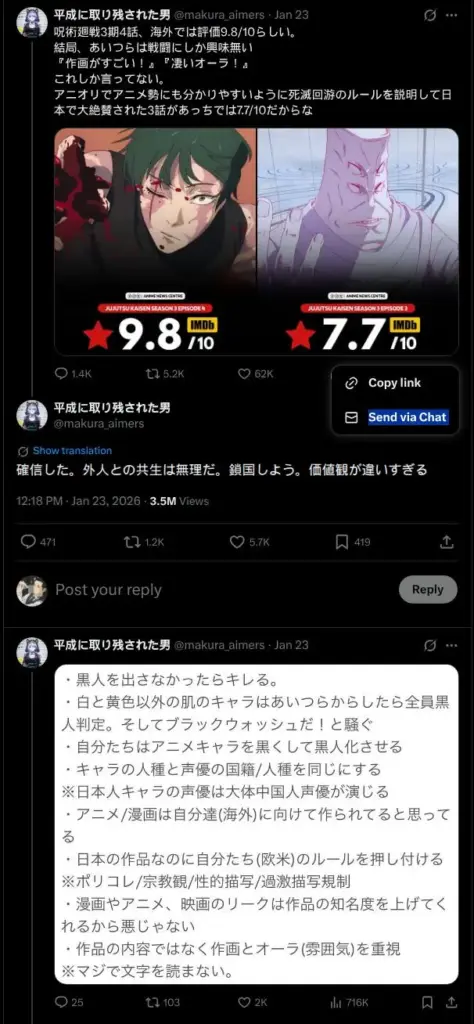
The user claimed that Jujutsu Kaisen Season 3, Episode 4, apparently received a 9.8/10 rating overseas. In the end, those guys are only interested in the fights. “Amazing animation!” “Insane aura!” That’s all they’re saying.
The episode, which explained the Culling Game rules in an anime-original segment to make it easier for anime-only fans to understand, and received massive praise in Japan, only scored 7.7/10 there.
The user also claimed that “I’m convinced. Coexisting with foreigners is impossible. Let’s close the country’s borders off. Our values are just too different.“
This user didn’t stopped here. The user later shared an image compiling what they believe are recurring problems with overseas anime fandom. While many of these opinions are extreme and controversial, the post gained traction among Japanese users:
“Regarding Black people: Characters with skin tones other than white and yellow are considered mixed-race. And they’re complaining about “blackwashing”! They are making anime characters Black and “blackifying” them.
* They want the character’s race and the voice actor’s nationality/race to be the same.
*Japanese characters are mostly voiced by Chinese voice actors.
They believe that anime/manga are made for them (overseas audiences).
They are imposing their own rules (Western rules) on Japanese works.
*Political correctness/religious views/sexual depictions/restrictions on extreme depictions.
Leaks of manga, anime, and movies are not bad because they increase the work’s popularity.
They prioritize the artwork and aura (atmosphere) over the content of the work.
*They literally don’t read the text.“
The user even gave an example of how overseas fans critisized Japanese Author of Gachiakuta for its character, Tamsy, being not transgender:
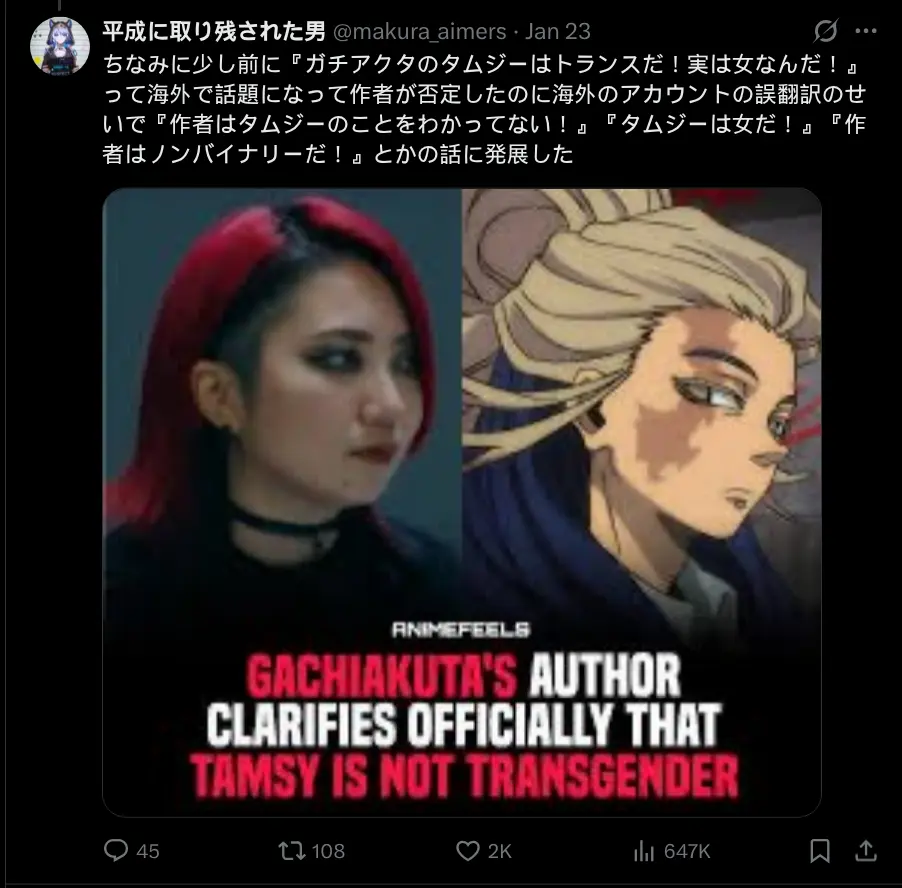
“By the way, a little while ago, there was a huge overseas buzz about “Tamji from Gachiakuta is trans! She’s actually a girl!” Even though the author denied it, because of mistranslations from overseas accounts, it spiraled into things like “The author doesn’t understand Tamji at all!” “Tamji is a girl!” “The author is non-binary!” and so on.“
More Japanese users criticised overseas fans for their overhyping behaviour for anime and not appreciating the positive things:
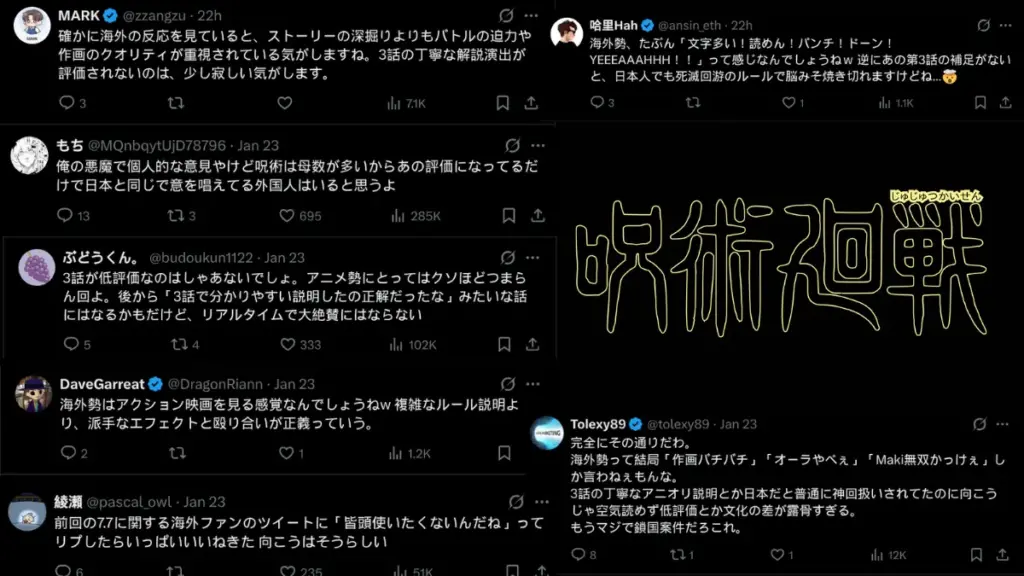
“Indeed, looking at the reactions overseas, it seems like they’re prioritizing the intensity of the battles and the quality of the animation rather than digging deeper into the story. I feel a little sad that the careful exposition in episode 3 isn’t being appreciated.“
“This is just my personal opinion, but Jujutsu has a large number of viewers, so I think it’s only getting that kind of rating, and there are probably foreigners who disagree with it, just like in Japan.“
“It’s no wonder that episode 3 has a low rating. For anime fans, it’s a boring episode. Later on, people might say things like, “It was a good idea to explain it in an easy-to-understand way in episode 3,” but it won’t be a big hit in real time.“
“It’s only natural that anime fans would rate it highly, since they don’t even know the difference between the original and the anime original.“
“I guess overseas fans think it’s like watching an action movie lol. Rather than complicated explanations of the rules, flashy effects and fistfights are what matter.“
“That’s completely true. In the end, all people overseas say is “the animation is amazing,” “the atmosphere is amazing,” and “Maki is so cool.” In Japan, the detailed original anime explanation for episode 3 would be treated as a great episode, but overseas, they don’t seem to understand the situation and it’s only rated low, making the cultural differences all too obvious. This is seriously a case of national isolation.“
“I replied to a tweet from an overseas fan about the last 7.7 event saying “I guess no one wants to use their brains” and got a lot of likes. It seems that’s how it is over there.“
“I’m sure overseas viewers are probably thinking, “There’s too much text! I can’t read it! Punch! Boom! YEEEAAAHHH!!” lol. On the other hand, without that additional information in episode 3, even Japanese people would have their brains fried by the rules of the Culling Game…“
The social media is flooding with criticism. What started as a discussion about animation quality has now evolved into a broader debate about cultural values, audience expectations, and the global consumption of anime. For many Japanese fans, the frustration lies not in overseas viewers enjoying the series, but in what they feel is a lack of appreciation for storytelling and context.
As anime continues to expand globally, such clashes may become more common — not because one side is necessarily right or wrong, but because the medium is no longer viewed through a single cultural lens.